Category: Chapter Business

  • VMN Regional Conference at Holiday Lake

    VMN Regional Conference at Holiday Lake

    VMNConference.8.29.15.cd
    Attentive VMN audience for the post-lunch panel discussion with representatives of our sponsoring agencies.

    It was an early start, even for someone who gets up every weekday at 5:30am. On Saturday August 29, 2015, I met Chris Bowlen and Adrie Voors at 6:45am in Grottoes to go to the Holiday Lake 4-H Educational Center in Appomattox for the Virginia Master Naturalist regional conference. Jerry Hopkins made the two hour drive separately, filling his car with Sandy Greene, Gretchen Achenbach and Carl Droms.

    It was worth the early rising!

    We arrived late (due to extenuating circumstance) but quickly got ourselves settled in our morning sessions. Eric Jones joined Chris and me for the Blue Ridge PRISM (Partnership for Regional Invasive Species Management) session about invasive plants. Rod Walker provided a lot of good information about the PRISM program, including the Mid Atlantic Early Detection Network and the EDDMapS (Early Detection & Distribution Mapping System) app.

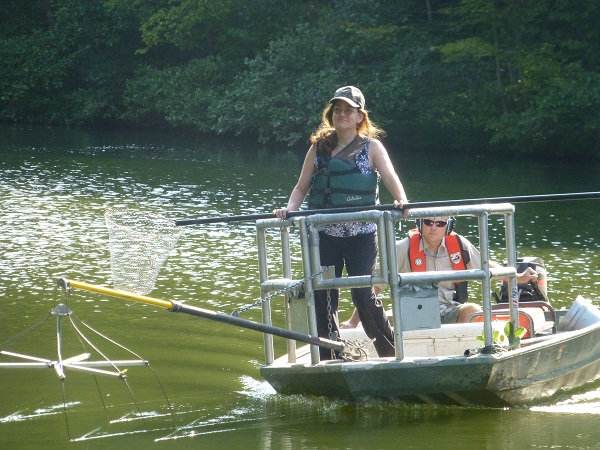
    Adrie and Carl attended the session on freshwater fish ecology presented by HMN Chapter Advisor Paul Bugas, Aquatics Manager for the Virginia Department of Game and Inland Fisheries. See Carl’s photos from this below.

    We had brought along our striking monarch display board which we were able to show off in the dining room during lunch, alongside other chapters’ displays. After a good lunch and some socializing it was time for the afternoon sessions. Again Chris and I were together, along with Eric Jones, at the RareQuest presentation. Chris Ludwig and Tom Smith talked about this exciting new initiative through the Natural Heritage Program. Recruiting has closed for this project, but more information can be found on the original announcement webpage.

    Afternoon sessions included a presentation by Kate Guenther, HMN CoHort I, on wildlife emergencies: how to Assess, Assist, Capture and Transport Injured and Orphaned Wildlife, knowledge Kate has earned on the job working at the Wildlife Center of Virginia for the past four years.

    Adrie, Jerry and Carl spent the afternoon learning about GPS navigation from Bill Perry, Area Forester Specialist for the VA Department of Forestry in the James River area. Adrie says she was really impressed with Bill’s ability to clearly explain how to use a compass and particularly enjoyed the outdoor orienteering part of the class.

    It was a great day, a long day, but lots of good information in a lovely setting.

    – by Elaine Smith, 2015 Training Class

  • Ready? … Set, … Go …!

    Ready? … Set, … Go …!

    Keeping in mind the whole goal is to accurately represent our Chapter activity as a measure of our support of the VMN Program . . . here are the figures with May added.

    RSGJune1.700

    So what could these figures mean?

    •  In 2014, May stayed pretty much the same as April 2014.  It will be interesting to see if this is a seasonal trend as logging takes a back seat to doing volunteer work.
    •  In 2015, May gave us a fewer people logging hours but also shows that the 2015 trainees are wasting no time getting into the system and getting their feet wet volunteering.
    •  Trainees in 2014 stayed the same in logging.  A good thing because this is when they were in class learning!
    •  * Trainees for 2015 had not yet started
    •  As was hinted in the first bullet point, I also am now realizing these figures can only show a trend.  Comparing figures from 2014 to 2015 is problematic as last year’s information could be showing hours entered retroactive to the actual month.  This time of year is also difficult to compare because in 2014 the trainees were just graduating and this year they are just beginning.
    •  The trend has taken another dip in 2015 with these May figures except for the trainees.
    •  We still have some catching up to do.  I know how tempting it is when you are super busy with Chapter volunteer work but too long a delay will make it increasingly difficult to catch up.  So please, take some time to enter those hours.  I know there are administrative hours out there to be logged.  If I can help in anyway, please let me know.  I have no problem entering hours for you, happy to do it – but only with your permission.

    June is coming and here are the numbers we have to beat:

    RSGJune2If anyone would care to verify these numbers you are more than welcome to do so – just give me a call and I will send you the spreadsheet and a “how to” document.

    – RoxAnna Theiss, June 2015

  • Quixote’s Column: Back to the Future

    Quixote’s Column: Back to the Future

    Bylaws History for Headwaters Chapter: Back to the Future

    Disclaimer: the following article is written from my personal perspective.  The story it tells is from my experience and of my opinion.  Call it an editorial piece.  – RoxAnna Theiss, May 2015

    So there we were October 27, 2011, finished with our assessments and getting ready to graduate and an email comes in from Paul Bugas on the morning of: a reminder to think about the slate of offices to be selected on our graduation evening . . . WHAT? Reminder? Officers? Board? What Board?  How did I miss this?

    Blindly we follow . . . I say that because I don’t think I was the only one confused.  I have no idea and I don’t remember how I found out about the various positions – must have been a handout I didn’t pay any attention to earlier because it wasn’t about the natural world per se – and there you have the crux of the matter: paying attention to chapter business was not high on any list of priorities I had.  Anyway, the Training Chair position called to me and I volunteered via email during the day of our last class to occupy this position.  We had our graduation and the various Board positions were volunteered and “elected”.  It was all very informal and quick – very quick.  Only four things come to mind from that evening:

    • Sassafras Tea
    • A “skills practical” that wasn’t
    • Eric Jones
    • We cherry picked and swapped among ourselves what we did and did not want to include as our various duties on the First Ever Headwaters Board

    Loved the tea – Sandy Greene now had real meaning for me on that night!  Confused about the skills practical . . .  what was that anyway?  Aware that someone I had just come to know at our Maple Flats outing over a keying question was also interested in Training.  I raised my hand first but Eric and I shook hands on working on Training together.  He’s been with Training ever since.  I paid no attention to the cherry picking or swapping.  I focused only on Training – a bad habit I would continue for two and one half years.

    A flurry of email activity followed over the next day or three:

    •  The first Board meeting date was decided
    •  Sophia sent the first VMN-VMS email
    •  We had our first “kerfluffle” over beavers (don’t ask)
    •  Our first Project Proposal was developed
    •  We got a huge wake up call about our first Annual Report due date

    We got the Bylaws, Operating Handbook and final agenda two days before the first Board meeting scheduled for November 10, 2011.  The Board meeting went well considering we didn’t really know what we were doing.  Paul could not make the first Board meeting but Jim Lawson came.   We forged ahead.  Turns out we got the Rivanna Bylaws which we adopted as our own, making revisions “at will”.  This had to be returned to the State Office post haste and we became a chartered chapter on the date we first met.  We never saw a blank state Bylaws template until years later.

    I can tell you now that we made some missteps – of course we did.  That’s to be expected.  However, they were more part of our eagerness to keep a momentum going than to ignore the state policy or even the Bylaws.  But ignore them we did.  Sophia was the primary alarm bell on our headlong progress.  I can only speak for myself on this but I didn’t think the Bylaws were important – then.  I do now.  I was totally fixated on Training and that’s the only part of the Policy and Chapter Operating Handbook on which I focused.   And focused I was and still am but with the added benefit of having now studied the Bylaws, Operating Handbook and Program policy as whole documents, in full context and with care.

    So we have come to a place where it would be safe to say we are a Board-centric chapter.  I think we all were oblivious to varying degrees concerning any consequences or ramifications.  The Board continued their scheduled monthly meetings and made the decisions for the most part – with the only nod to membership governance called for in the Bylaws occurring at the Annual meetings where Bylaws amendments were to be considered.  And then not in any way that seemed to engage.  In our defense: I really don’t know how else we could have done it.  There were only seven on that first Board and although the suggestion was made to reach out to the rest of our 2011 class to engage and involve, we decided instead to focus ahead on the first Basic Training we would organize as a Chartered Chapter.

    But consequences do come about as a natural course of things and I am well aware of ramifications at this point.  At a recent 2015 Training class we had a reception for our state sponsoring agencies – it was a smashing success by the way – and at the end of the event, one of our busiest and most elusive agency representatives blew me out of the water and brought home something over which I have been agitated for several months: general membership meetings.  He asked very pertinent questions about those meetings and referred me to his involvement with several chapters who do have regular meetings.  He wants to be involved with Headwaters in that same way.  He was very intense about it.  Said he: “When Headwaters is ready to have regular chapter meetings . . . “.  You don’t have to take my word for it – I have a witness.

    This is why I have subtitled this article: Back to the Future.  Our newest trainees are an amazing group.  So eager they are, with so much to offer and so interested in Headwaters.  They have quizzed me more than once about getting to know other chapter members.  They were disappointed no one showed for their Sponsoring Agency event from the Chapter save Carl.  They like Carl, don’t get me wrong.  They like Judy.  And they love Eric!  You can ask Carl, Judy and Eric about this class and how special they are as a group.  You don’t have to take my word for it.

    It is for them I speak.  It is for their sake I plead my case: let’s examine the Bylaws and policy for hints and advice about our future agenda and chapter strategy.  Let’s find a way to be a Chapter as an entity instead of individuals who meet at occasional volunteer opportunities or advanced trainings.  In truth, I plead my case for the chapter as a whole – all four cohorts!  Check out the clues I have already mentioned about the intent and design inherent in the State policy and Chapter Bylaws.  Let’s get back to our future as a whole community with seats at the table for everyone – and I don’t mean blanket invitations to the Board meetings either.   I mean an involved and engaged membership – all 52 of us!  Because with this class I dare to say they are more than ready to be contributing members.  You don’t have to take my word for it – come see for yourselves.

  • Ready? … Set, … Go …!

    Ready? … Set, … Go …!

    Keeping in mind the whole goal is to accurately represent our Chapter activity as a measure of our support of the VMN Program . . . here are the figures with April added.
    R.S.G.May2015So what could these figures mean?

    •    In 2014, April gave us fewer people logging hours showing a bump in the road which probably reflects very busy Spring in 2014.
    •    In 2015, April gave us a few additional people logging hours and shows that the 2015 trainees are wasting no time getting into the system.
    •    Trainees in 2014 also experience a lag in logging – probably the same reason – too busy volunteering!
    •    * Trainees for 2015 had not yet started
    •    As was hinted in the first bullet point, I also am now realizing these figures can only show a trend.  Comparing figures from 2014 to 2015 is problematic as last year’s information could be showing hours entered retroactive to the actual month (hours entered later than the actual activity date can contribute to better percentages for 2014 but not 2015 because there is not much retro entry to accumulate yet.  Each of these early 2015 months may look quite different when we catch up with logging our past activity for this year).

    The trend is looking better for 2015 with these April figures.  We still have some catching up to do.  I know how tempting it is when you are super busy with important Chapter work but too long a delay will make it increasingly difficult to catch up.  So please, take some time to enter those hours.  I know there are administrative hours out there to be logged.  If I can help in anyway, please let me know.  I have no problem entering hours for you, happy to do it – but only with your permission.

    May is coming and here are the numbers we have to beat:
    R.S.G.2.May2015If anyone would care to verify these numbers you are more than welcome to do so – just give me a call and I will send you the spreadsheet and a “how to” document. – RoxAnna Theiss, May 2015

  • Quixote’s Column: Interpretation of Our Governing Documents

    Quixote’s Column: Interpretation of Our Governing Documents

    Did you know our Bylaws are actually quite an interesting document?  It’s a document with a history, some intrigue and the potential to be a boon or a bomb!  Spoiler alert: there is a bonus at the bottom of the column.

    For instance, did you know that the governance of the chapter provided for in our Bylaws rests with the Chapter membership?  It’s true . . . no joke!

    There are clues throughout the document.  However, just like any situation in life, the document needs to be considered as a whole – cherry picking can change the meaning.  And so as the Bylaws committee discusses proposed amendments to our current Bylaws we return to the original document template.

    The original template used here has been paraphrased, in the interest of space, and presented with author’s interpretation before any changes were made by others or by Headwaters (but that’s a future post on history).  The state program provides this template with the following conditional statement (emphasis from column author):

    “This document is for use at the chapter level.  It details the rules by which the chapter will be governed.  In order to get their official charter, chapters should draft and adopt their own bylaws based on this template document.  The highlighted sections of the document indicate areas in which the chapter should set its own policies. The un-highlighted sections indicate statewide policies.”

    The complete original state template is available here.

    Take a look at this (emphasis from column author and the text to which you might want to pay attention initially – to avoid Bylaws burnout.  You might also skip to Bottom line and then retrace):

    ARTICLE VI – Board of Directors and Executive Committee
    A. Composition, Rights and Responsibilities

    3. Authority.
    The Board of Directors shall have the power to conduct the business of the Chapter as defined in these bylaws or approved by the membership.

    4. Authority Boundaries.
    All resolutions and actions that do not fall within the assigned duties of the Board of Directors or are not assigned by these bylaws will be presented to, and voted upon by the general membership at a duly called and convened general meeting.

    B. Executive Committee

    1. Composition.
    The Executive Committee shall include the officers of the chapter.

    2. Authority.
    In the event that board action is required before a board meeting can be called or the matter does not warrant calling a special meeting, the Executive Committee may take action with the same authority and boundaries as the board.  Such action must be reported to the entire board within one day of taking the action.

    ARTICLE VII – Meetings
    A. Board Meetings

    1. Frequency:
    The Board of Directors may meet as often as required but shall meet at least (state the minimum meeting schedule. Example: quarterly.).

    2. Notification:
    The Chapter membership shall be notified of all Board meetings at least ten days prior to the meeting.

    3. Open meeting.
    Attendance at the meeting shall be open to all Chapter members.

    B. General Membership Meetings

    1. Frequency.
    General membership meetings or other Chapter-sponsored activities will be held (state the minimum meeting schedule. Take into account planned breaks for summer, holiday, etc. Example: monthly from September through May). Special meetings may be called at the discretion of the President.

    4. Governance.
    The acts of the majority of the voting members present at each duly called and convened meeting shall be the acts of the General Membership.

    ARTICLE X – Amendment of Bylaws
    A. Approval before Vote.

    In order to ensure consistency, continuity and adherence of statewide guidelines, the Chapter Advisor(s) and then the Virginia Master Naturalist Program Coordinator, as a representative of the State Steering Committee, must approve amendments to these bylaws before they can submitted to the Chapter’s general membership for a vote.

    B. Notification.

    Notice of all proposed amendments to the bylaws with the date, time and place of consideration shall be presented in writing to Chapter members at least 30 days prior to consideration by the membership.

    C. Membership Vote.

    These bylaws may be amended by a two-thirds vote of members present at a General Membership meeting of the Chapter.

    ARTICLE XI – Dissolution
    A. Dissolution Procedures. The Chapter may be dissolved via either of the following procedures:

    1. By the Membership.

    a. Prior to a vote on dissolution, the Virginia Master Naturalist Program
    Coordinator must approve the proposed dissolution.
    b. The proposal for dissolution must be presented at a General Membership or
    special meeting 30 days prior to the vote.
    c.  A vote of 2/3 of the Certified Members present at the General Membership or special meeting is required for dissolution.
    d.  A letter must be submitted to the State Steering Committee stating the results of
    the vote and why the chapter chose to dissolve.

    2. By the State Advisory Committee.  By notice from the State Steering Committee.

    Bottom line:

    So what do you notice about the above examples?  Again, the above is paraphrased from the original template, but on the subject of governance, here’s what catches the eye:

    Board and Executive Committee authority comes from the Bylaws and/or the membership.

    The Board and the Executive Committee have boundaries on their authority!

    The state suggested example of the frequency of Board meetings is quarterly

    The state suggested example of the frequency of General Membership meetings is monthly

    The only place noted in the Bylaws directly concerning chapter governance is under Article VII, B, 4 – General Membership meetings and is given to those members in attendance.

    The Board does not appear to have approval authority on proposed Bylaws amendments, although it is the Board that appoints the Bylaws Committee to review/suggest amendments to existing Bylaws.  A formal review occurs at Advisor and state levels before presentation to the membership (by the Bylaws Committee – author’s interpretation of Robert’s Rules of Order) at a duly called General Membership meeting planned by the Board.   Although, I am certain the Bylaws committee will respectfully present its recommendations to the Board for review.

    As far as dissolution is concerned, there is no guidance about where the dissolution proposal comes from, but it is clear that, after the proposal is made, the only action required by the Board is to call a General Membership or Special Meeting.  Final decision rests with the membership.

    A close look at state policy, the state template of the Chapter Operating Handbook and the state template of the whole of the Bylaws that gives the skinny on what the Board’s assigned duties are and can be found in this document.

    You know, all this may seem dorky and wonk-ish but the truth of it is: Headwaters is your chapter – as long as you own it.  Hopefully, this is not an exercise in tilting at windmills, but membership in a Virginia Master Naturalist Chapter does have responsibilities (again, it may be helpful to skip to the emphasized text before retracing to the context):

    ARTICLE I – Chapter
    Chapter Identity and Relation to State Program/Organization
    A. Parent Organization.

    The parent organization is the Virginia Master Naturalist Program or “State Program”.

    E. Commitment to Virginia Master Naturalist State Program Requirements.

    In return for the general supervision, guidance, supplies, resources, and cooperative helpfulness afforded by the Statewide Virginia Master Naturalist Program, a Chapter of the Master Naturalist Program agrees to comply with all requirements, guidelines, and standards and to produce and submit an annual report conforming to the standards set forth by the State Advisory Committee.

    F. Revocation Compliance.

    In the event this chapter ceases to follow Master Naturalist State Program guidelines, the Chapter agrees to abide by revocation of the Chapter’s charter along with the right to use the Virginia Master Naturalist name, title and trademarks.

    ARTICLE III – Purpose
    A. Overall Purpose.

    A Chapter is not organized for profit, nor shall any of its net earnings inure in whole or in part to members, employees, or other individuals. In support of the State Program Sponsors, this Chapter shall be an educational, non-profit, volunteer organization dedicated to fulfilling the State Program’s mission to develop a corps of well-informed volunteers to provide education, outreach, and service dedicated to the beneficial management of natural resources and natural areas within their communities for the Commonwealth of Virginia . . .

    ARTICLE VIII – Compliance with Master Naturalist Volunteer Policies
    A. Compliance.

    All members of the Chapter will adhere to the volunteer policies as established by the Virginia Master Naturalist Program and designated in the Volunteer Policy Handbook and Guidelines.

    B. Violation.

    Violation of volunteer policies is a serious matter that reflects unfavorably on the entire Chapter. A formal process to investigate a charge of misconduct against anyone who is in training or certified, as well as disciplinary actions for those found in violation of the policies has been established by the Virginia Master Naturalist Program and will be used to deal with these violations.

    Well, there you have it, this month’s post of Quixote’s Column is an effort to fulfill another state guideline (this comes from the VMN Program Volunteer Handbook and Policy Guidelines, pg. 13):
    Key Elements of the Chapter Management Guidelines:

    •  Maintain the program as an unbiased public service.
    •  Recognize one’s responsibilities as a Virginia Master Naturalist.
    •  Recognize the autonomy of the various partners when coordinating or implementing projects and other chapter events.
    •  Keep accurate records.
    •  Present a positive public image that speaks well of the Virginia Master Naturalist
    Program.
    •  Actively participate as a team member with other individuals of the Virginia Master
    Naturalist Program.

    Local Chapters should be instrumental in making members aware of these key elements of the State Program as well as their own bylaws, policies and procedures.  Chapters shall be vigilant and responsible for ensuring members and affiliates are following policy.

    If you are wondering about the Policy Police – there are none at the state level of which I am aware.  Being a VMN is based on the honor system because we don’t need to be policed – just reminded/informed on occasion.  Why should you care about any of this dorky wonk-ish stuff?  Well, it’s not necessary to care about it.  Headwaters will not change one way or the other.  The amazing synergy that is Headwaters comes from the grace and good faith of its volunteers.  I see this column as a chance to tell a story and establish some history.  I hope Quixote’s Column will provide a bit of a framework for the future.  It’s always good to have a historical perspective and an understanding of guiding principles but in the end, the Chapter will be what we all want it to be.

    BONUS at the bottom:  If this interests you and you choose to do the research implied in this column to be fully informed and engaged, you may earn one hour each month the column appears in Advanced Training (Continuing Education) by sending your comments/ observations to: headwatersmn.info[at]gmail.com

    Next month: “Bylaws History – a path forward!”

    – RoxAnna Theiss, April 2015