Once a bright and sure sign of autumn, monarch butterflies are now in worrisome decline. Scientists have tracked their decreasing numbers for several years. A recent study showed the lowest ever population of migrating eastern monarchs.
A number of factors have contributed to the decline of the monarch butterfly. Here in the United States, industrialized farming involving wide scale spraying of pesticide that kills all vegetation but the food crops modified to be immune to it is a major factor. We are losing high percentages of the native flora, especially milkweeds, which monarchs need to survive, in favor of homogenized landscapes. Farms growing only one crop and non-native green spaces such as lawns and pesticide-treated roadways, contribute to the problem.
In Mexico, deforestation, especially illegal logging, contributes to the habitat loss of monarch butterflies and reduces their numbers.
Additionally, severe weather such as extreme cold and drought has been identified as a factor leading to the loss of monarchs.
We can help as individuals by using less pesticides and growing our own milkweed to welcome back the monarchs.
Learn more about their situation and what you can do through MonarchWatch.org.
More from NationalGeographic.com, October 10, 2014, here:
Kate at her busy post managing the Wildlife Center’s front desk.
The story that grabbed my heart this year is of a critter that never entered our doors.
JANUARY 2013
Last winter I got a call from a woman named Becky in far southwest Virginia who wanted to know what she could do to keep her female hummingbird warm during the anticipated cold snap that was coming in February.
WHAT??!!!
Becky explained to me that this bird, a somewhat larger-than-usual female Ruby-throated Hummingbird, had not migrated in the fall when all her cohorts had left. And, somehow, the hummingbird was surviving through the cold January nights, albeit with the help Becky was providing by continuing to offer the nectar feeder around the clock every day. When a Ruby-throated Hummingbird overwinters here it usually is because it is ill, injured, or a “genetically inferior” individual, and it would be likely to die in migration if it tried to go.
Each day, Becky changed the nectar mix to make sure the feeding holes didn’t ice over. She went out periodically and brushed snow off the perch. The bird roosted at night in a dense holly which afforded some protection from the snow and wind. That was all the bird had as protection. Becky was investing a huge amount of time and energy into providing the only sustenance this bird could have found anywhere in the area. Without her dedicated attention, it seems surely the bird would have frozen or died of hypoglycemia.
Becky asked whether she should increase the ratio of sugar to water to give more calories. We cautioned her against this, and instead offered that if she wanted to do something more, she could buy a professional quality hummingbird feed that would replace some of the proteins and minerals that the bird would have normally gotten from eating insects; this product is more complete than the simple carbs of sugar water. Unfortunately, that food would cost her about $100 to order online. She said she was going to consider it. I hung up with a feeling of sadness knowing that snows and colder temperatures—into the teens or lower—were forecasted.
JUNE 2013
Becky’s committed effort had touched my heart. I kept her phone number, arguing with myself about whether or not I wanted to hear the outcome of her winter’s effort. In June, I nervously dialed the phone to check up on the outcome. Astounded, I learned that the female hummingbird had survived the winter and rejoined with the other half dozen or so ruby-throats that had returned in the spring! Becky had decided to name this bird “Mira” for miracle, and had earned the right to do so, I thought.
NOVEMBER 2013
Writing up this story, I decided to call Becky one last time to clarify some details. She informed me that a late season hummingbird was at her house — again – after the others had left for the season. It is roosting in the same holly bush and is slightly larger than most other hummingbirds of summer were. She suspects it is “Mira.” Ruby-throated Hummingbirds usually leave Virginia by mid-October to winter in Mexico and Central America.
Again, there is nothing to indicate why the bird didn’t leave with the others a month ago—no known injury or disability. This year, Becky is planning to take down her last feeder to encourage “Mira” to leave before it is too late again this year. Leaving feeders up does not cause birds to delay migration. It is the change in day length that triggers the migration instinct in birds, not availability of food. Still, maybe it will encourage her…
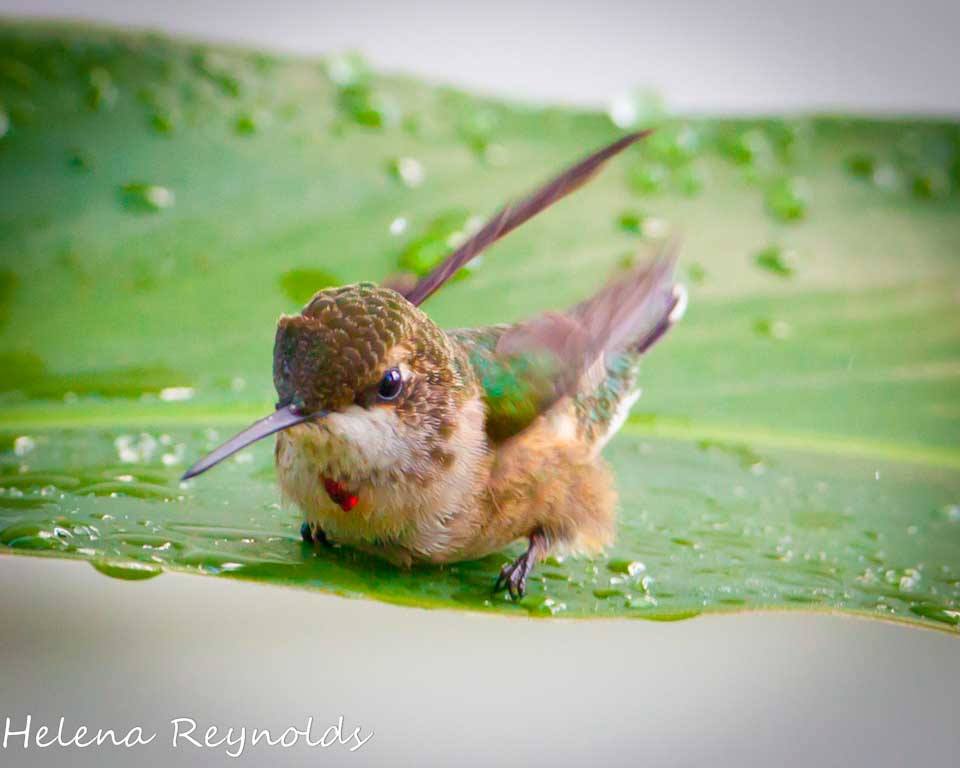
Could this be Mira? photo of Rufous Hummingbird by Helena Reynolds/Project FeederWatch
There is another additional possibility. Sometimes, hummingbirds that overwinter in the east may not be our native ruby-throated hummingbird species, but instead the slightly larger, more cold-tolerant vagrant species Rufous Hummingbird (Selasphorus rufus) which have been seen with increasing frequency in the eastern USA. Could this be her Mira?
I don’t know if I’ll have the heart to check in with Becky again or not. But I have saved her phone number just in case.
–Kate Guenther, Virginia Master Naturalist and Wildlife Center of Virginia Front Desk Coordinator | Reprinted here with her permission. Originally published in the Wildlife Center of Virginia blog on December 29, 2013.
Headwaters Chapter certified master naturalist Stephanie Gardner penned a monthly naturalist column for our area’s Daily News-Record’s North Fork Journal and Shenandoah Journal in 2012.
In her words, here’s how Stephanie got started as a columnist:
Stephanie
In autumn of 2011, Lauren Jefferson, then editor of the Daily News-Record’s North Fork Journal and Shenandoah Journal, was looking for a nature writer as a 2012 monthly guest columnist. She had recently written an article on the Virginia Master Naturalists training course and thought a Master Naturalist might make a good potential guest nature author and photographer. She also wanted the columnist to be from one of the areas served by her publications.
Rivanna Master Naturalist, Jim Lawson, passed along my name to her as a Virginia Master Naturalist who had recently moved to Bridgewater, Virginia. I had recently completed Master Naturalist training in Blacksburg, Virginia through the New River Valley chapter and was in Bridgewater as the new Special Collections Librarian at Bridgewater College. I started writing the column and later was happy to connect with the Headwaters Chapter. I declined payment for the column and used it toward fulfilling my Virginia Master Naturalist volunteer hours in 2012.
It was great fun to write and research the columns. Although I am certainly not the most qualified person to write on many of these subjects, I learned a lot and hope the columns sparked interest in citizen science among their readers.
Find links to many of Stephanie’s Adventures of a Citizen Scientist columns in the image captions below.
The Nature Nuts 4-H Club is one of over 20 groups available to Augusta County youth through the Virginia Extension Service’s 4-H Youth Development program. It serves as a project vehicle for several Headwaters Master Naturalists including Ann Murray giving us this 2013 review.
4H Nature Nuts cleaning their adopted stream, Lewis Creek, in Gypsy Hill Park in April
In 2013, the Nature Nuts have had a variety of interesting programs. We had a beekeeper open hives for us and teach us about bees. We had an educational tour and hike at the Wildlife Center of Virginia. We held an environmental game booth at Earth Day, Staunton, and then hiked in and cleaned litter out of the stream at Gypsy Hill Park. We had older kids teach us how to do presentations. We collected, identified and counted macro-invertebrates from Middle River. The kids learned how to build a fire and cook in the fireplace.
4H Nature Nuts on their 5 mile hike through North River Gorge in July
This season, Gretchen Achenbach (Master Naturalist) gave a fascinating power point presentation on bats. We toured and had a “turtle walk” at Grand Caverns. We identified and drew leaves and trees. Early this year we’ll begin a unit on Virginia woodland habitat and forest animals. Oh, yes! We camped over at Sandy Greene’s log cabin in tents and hiked 5 plus miles in the George Washington National Forest, North River Gorge! All these adventures and we haven’t lost a child, yet! The leaders of this fine group have been Sandy Greene, Ann Murray and Judy Tammi, Master Naturalists. This year we added a new leader, Sheila Price, a Mom and past 4H-er. For more information about how to join our group call Ann Murray (540) 363-5304.
Augusta CBC’s prize finding was a Dunlin like this one taken by Tony Sutton, posted to Flickr. Click on the image for more about Dunlins from Cornell.
The 114th Audubon Christmas Bird Count took place from December 14th, 2013 – January 5th, 2014 with approximately 2300 circles and close to 70,000 participants. The local Augusta CBC was begun in 1966 with seven participants and has run consecutively for 47 years. Our circle’s center is in Verona with a 7.5 mile radius. This year, on December 15th, 2013, we had eight teams consisting of 26 members and friends logging in a total of 497.5 miles and over 55 hours in the field. With a total of 81 species counted for the day, this number breaks the previous two high records of 80 species in 2005 and 2009. The cumulative number of species for the Augusta CBC is 134 with 66 being the average.
Some highlights for record numbers from the 47th CBC were 82 Gadwalls, 6 Wood Duck, 6 Hooded Mergansers, 3 Bald Eagles, 8 Red-shouldered Hawks, 68 Red-bellied Woodpeckers, and the biggest find of the day was one Dunlin. Allen Larner had spotted the Dunlin earlier in the week and it was still located on the same pond on Bell’s Lane for the CBC. There is only one other Dunlin noted for a CBC in 1979 and only the third winter record. A Peregrine was also found clocking in as the fourth CBC record and one Catbird, the seventh CBC record. Also of note are the infrequent CBC records for owls in general. This year we had 3 Short-eared Owls, 1 Great Horned, 1 Screech Owl and 2 Barn Owls with a high of 4 Barn Owls being recorded in 1971 and none at all from 1992 – 2006. Please keep in mind these are only CBC records, not winter records for Augusta County.
YuLee Larner, one of the founders of the Augusta Bird Club, one of the original participants for the Augusta CBC and the compiler of our records from 1966 onward, gave me her hand written, hand typed records for the CBC before she passed away in 2013. It is such a pleasure to pour through the sheets and to reflect on this living document and also to reflect not only on her efforts but on the other individuals as well over the course of time who have made significant contributions in our birding community and beyond. It is a joy and an honor to continue the local CBC tradition!
 Once a bright and sure sign of autumn, monarch butterflies are now in worrisome decline. Scientists have tracked their decreasing numbers for several years. A recent study showed the lowest ever population of migrating eastern monarchs.
 In Mexico, deforestation, especially illegal logging, contributes to the habitat loss of monarch butterflies and reduces their numbers.