Garden beds on the left, rising in front of the Wildlife Center.
Thursday, February 27, Master Naturalists and friends finally got a break from Grandfather Winter (as Don P. calls it) to allow us a workday at the Wildlife Center. We accomplished more than I think any of us thought we would. The day started off blustery and cold, but our hearts were warmed when RoxAnna T. expertly lumbered her neighbor’s massive truck and trailer of gravel up to the side of the building.
We labored and laughed until lunch break building the raised beds and installing the foundations for the rain barrels. After lunch we had enough energy to spare to get the whole pond dug. Credit for that goes largely to Jeff and Frank who shoveled and shoveled and shoveled.
Sandy G. led her team to deconstruct one of the rotted out signs and clean up the area for future installation of nest boxes and signs.
It was a fantastically successful day—thanks to the 13 volunteers who came. Hearty THANK YOU goes to: Ann Murray, Carolyn Tudor, Frank Deckert, Holly Parker, Jeff Shifflett, Judy Tammi, RoxAnna Theiss, Sandy Greene, Sara Doherty, Stephanie Gilman, Sue Eckroth, Adrie Voors.
It’s been almost a year since our last outing with Seth Coffman of Trout Unlimited to the Mossy Creek restoration site. Last April our Basic Training class saw “before restoration” of the 2500 foot length of this unique and nationally known spring feed creek just south of the turn off from Route 42 onto Mossy Creek Road. The restoration process scheduled for that summer was outlined then. This year, on the last Saturday in February, Seth took several of the current class: Kelly Rourke, Sue Eckroth, Ginny Hoffman and Bob Forrest, in addition to a representative from last year’s class, Chip Brown, and our Charter class of 2011: Betty Forrest and RoxAnna Theiss, to the same site to see the amazing difference a year can make.
Click on the image to watch an informative 31/2 minute WSLS news report about the Mossy Creek restoration project.
In July of 2013, heavy equipment and funds from the National Fish and Wildlife Foundation restored this area to a more natural meander and flood plain form. We saw the results first hand on this unusually warm and sunny February weekend. Seth explained the differences between spring fed creeks such as Mossy Creek and free stone creeks fed by run off. He highlighted what colonial settlement and farming practices had done to dramatically change this local stream system over the past 100 years. After extensive archeological documentation of the site, the old dam that had served several different mill works was partially demolish to restore the natural flow of the stream. This year the project will work to stabilize the restored stream banks to prevent new erosion and reintroduction of sediment to the streambed.
Although Mossy Creek is on private land, the overall project called the North River Watershed Restoration Project under which Mossy Creek falls is partnered with local, state and federal government as well as with private agencies such as the Virginia Conservation Network and the Valley Conservation Council. The benefits of such stream restorations go far beyond the local level – all the way downstream to the Chesapeake Bay. Mossy Creek is well worth our volunteer efforts. After all, the old adage is indeed true: We all live downstream!
Patti doing her thing during the 2013 Buffalo Gap trip. photo credit: Tom Long
On a cold and raw Tuesday in late February a hardy band of eight met at the Virginia Department of Forestry (VDOF) Buffalo Gap Work station near Churchville. Six trainees: Kelly Rourke, Janet James, Malcolm Cameron, Sue Eckroth, Ginny Hoffman and Janet Joseph joined two chapter members from the 2011 Charter class Jerry Hopkins and RoxAnna Theiss to get instruction on identifying trees in the wintertime from VDOF’s Patti Nylander. Patti had given similar instruction just about a year ago to our last Basic Training class. Although it was raw and breezy this year – last year the conditions were considerably tougher. Patti took the improved conditions opportunity to prepare a more detailed and leisurely instruction this year.
We started with some roadside lessons about the basics of tree structure: opposite branching patterns (Maples, Ashes, and Dogwoods – or MAD) and alternate branching patterns (everything else) and how it starts us down the winter tree ID path. Patti showed us the distinguishing characteristics between the two main Oak families: Red Oak and White Oak using the fallen leaves on the ground. Leaves from trees of the Red Oak family such as the Scarlet Oak, the Black Oak and the Pin Oak all have sharp needle-like points at the end of each leaf lobe. Conversely, trees from the White Oak family such as the White Oak, Chestnut Oak and Post Oak all have rounded and smooth edged lobes. There are also consistent differences in the acorn each Oak family produces. This was not an easy lesson to give as this past fall was a very poor year for acorn production all across the oak trees.
We then moved into the woods where individual trees were discussed. Their value as timber, wildlife food and place in the forest canopy were outlined along with key bark attributes of texture, smell and taste. Yes, taste! The bark of those trees with high tannin content have a bitter sting on the tongue and often make livestock ill if they browse on the bark or branches. The Black Oak from the Red Oak family is one such tree with the added twist of having a bright orange cambium below the bark’s crust.
One of the reason’s Patti likes using this site is the variety of trees represented here. We visited her favorite tree: the Shagbark Hickory and learned of its value in sheltering bats and other small wildlife under its loose peeling bark. We experienced the wintergreen scent of the Black Birch and saw first hand the unusual 90 degree branching pattern of the Black Gum. Patti frequently quizzed us to see if the information was “sticking”.
At the end of the lesson, Patti shared some history of the Virginia Department of Forestry that is celebrating its 100th year in 2014. Back in 1914 the infant agency had one full time employee and its sole mission was fire suppression. She tracked the agency’s growth through the twentieth century and outlined its expansion into forest management and work with private landowners. VDOF is currently partnering with the United States Forestry Service to manage and conserve Virginia’s diverse and significant woodlands.
It was a grand day and a perfect cap to the field trip offerings for the fall session. Onto the Spring session with lots of exciting and unusual trips planned for the 2013-14 Basic Training class.
Venture down Ore Bank Road tucked into the southern corner of Rockingham County in the shadow of the Blue Ridge Mountains and you will find the Deep Run Ponds Natural Area Preserve. Dotted with sinkhole ponds, this local treasure supports many ecological features unique to the Headwaters Master Naturalists service area.
Recently expanded from 700 to 900 acres, the land creating Deep Run Ponds Preserve was acquired in 2001 by the Natural Heritage Program arm of the Virginia Department of Conservation and Recreation. The Natural Heritage Program is common to every state, with a mission of conserving native biodiversity by preserving sensitive natural areas.
The Projects Committee of the Headwaters Master Naturalists enjoyed a recent ramble through Deep Run Ponds Preserve guided by committee member Chris Bowlen and Natural Heritage Stewards Ryan Knopf and Wes Paulos, who work out of Roanoke. Ryan says the area offers ample potential projects should HMN decide to take them on. From trail work to flora and fauna inventories to hydrological monitoring … all efforts would be welcome.
Shenandoah Valley Sinkhole Ponds are characterized by depressions created in limestone karst bedrock covered by 100 or more feet of sand and silt washed down from the adjacent Blue Ridge Mountains.
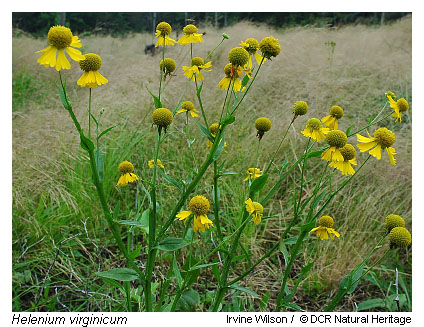
The rare Virginia sneezeweed (Helenium virginicum) grows only on the edges of sinkhole ponds. This perennial herb in the aster family is found here and in the Missouri Ozarks and nowhere else in the world. This ecological niche also favors other rare species found in the Deep Run Ponds Preserve, including the Black-fruited spikerush (Eleocharis melanocarpa), Northern St. John’s-wort (Hypericum boreale), Buxbaum’s sedge (Carex buxbaumii) and Northern bog clubmoss (Lycopodiella inundata).
The eight numbered “vernal” sinkhole ponds of the preserve are fed by runoff seepage from the nearby roads. Most likely dry in the summer, visiting the area in winter is recommended for seeing the ponds full and too avoid the dense tick population active in the warmer months.
Once home to the Schreckhise nursery, the area’s sandy soils prompted the company to move its operation, but not before introducing an interesting mix of landscaping plants into the forest.
Ryan says his agency’s plans for Deep Run Ponds include improved public access so more people can learn to care for this special place in our backyard.
The Virginia Natural Heritage Program is in the process of hiring another steward who would work out of Verona. Having this third and more local program field worker will facilitate our chapter’s considerations of developing a future focus project out of this interesting place.
The Shenandoah Chapter of the Virginia Native Plant Society (VNPS) has adopted Deep Run Ponds for organized previous trash removal and current garlic mustard removal event days. Consider joining master naturalist Chris Bowlen of VNPS on Tuesday, March 25 from 10 AM- 2PM for this year’s annual day of extricating invasive garlic mustard from Deep Run Ponds.
Sinkhole pond
Sandy, Chris, RoxAnna, Betty and Bob
Frozen Pond #1
Sawtooth Aspen stand
Forest floor lichen and mosses
Project committee members learning about sinkhole ponds.
Headwaters own Betty Gatewood: educator, artist, Master Naturalist!
Three Headwaters members set out on Sunday morning, January 19th to the Walker Nature Center in Reston, Virginia, to hear one of our own present on the History of the American Chestnut as a teaching story for children. RoxAnna and Betty Forrest are from the same Headwaters 2011 Basic Training class as Betty Gatewood – the program presenter. Stephanie joined the Headwaters Chapter from the New River Chapter in Blacksburg and provided safe navigation to our Reston destination.
On the way, Betty Forrest expressed her excitement over hearing that Betty Gatewood was going to talk about the American Chestnut. She shared with Stephanie and RoxAnna how very important to Betty G. and her husband Mark the restoration of the American Chestnut trees is. Of Betty Gatewood she says: “Betty G. always greets you with a smile and you know she is going to impart knowledge in a very exciting manner, with her excellent illustrations of plants on her book marks. Both Betty and Mark are avid hikers and are perfectly suited to be the ones to talk on this cause”.
We reached the Walker Nature Center in plenty of time to meet some of the other participants. The small conference room was filled with an assortment of attendees to the tune of over twenty people. The Virginia Master Naturalist Program was well represented. In addition to our Headwaters Chapter, the VMN Pocahontas Chapter based in Chesterfield County and the Richmond Metro Area and the VMN Banshee Reeks Chapter based in Loudoun County joined members of The American Chestnut Foundation (who organized and sponsored the event), the Virginia Master Gardeners Program, the Frontier Culture Museum, Fox Haven Nature Center and Johns Hopkins Environmental Studies Program to be guided by Betty’s experiences and hopes for the future of children and young people learning from and in the natural world.
The American Chestnut, Castanea dentata, was one of the most important eastern forest trees before being practically eliminated in the early 1900s by an airborne bark fungus causing chestnut blight.
The program began with introductions by all attendees. Betty G. then presented a number of excellent resources that educators can use in teaching the history, preservation and reintroduction of the American chestnut. The resources we were shown place emphasis on hands-on learning and are curricula that focus on getting children outdoors. Betty noted how a variety of learning goals can be met with such outdoor education. Through work with American chestnuts, children will learn and improve skills of observation, problem solving, use of technology and stewardship of resources. Outdoor education is also beneficial to children’s physical and mental health.
Presentation attendees enjoyed exploring the Chestnut Learning Boxes on our tables. The boxes are available from The American Chestnut Society. These big plastic tubs contain binders with curricula detailing activities using the box’s many specimens including leaf samples, burr specimens and tree ring slices. The learning boxes are designed for junior high and high school students.
The American Chestnut Foundation –VA Chapter is very active, hosting citizen science opportunities and providing learning resources. Presentation attendees were introduced to the Appalachian Trail Mega-Transect Chestnut Data Project, an effort using volunteers to identify, map and collect data on the American chestnut trees along the Appalachian Trail. Details are found on the VA Chapter website.
We also learned of the Trail to Every Classroom Project of the Appalachian Trail Conservancy and the National Park Service. This program provides resources enabling teachers of kindergarten to high school-aged students to use the Appalachian Trail as a site for service learning.
The Virginia Governor’s School is another institution that is building science, technology and problem solving skills in young people through innovative hands on education. We learned of a cutting edge scientific project carried out by students concerning the preservation and reintroduction of the American chestnut. The Valley/Ridge Regional Summer Governor’s School serves our area and has a component at James Madison University.
And just as Betty Forrest promised, a final highlight of the presentation was the lovely bookmarks given to us by Betty Gatewood and featuring her beautiful watercolor artwork of chestnut burrs and leaves. Thank you, Betty!
After the presentation, some participants went for a brief hike outside the Walker Nature Center. We visited a young American chestnut tree on the property. It was good to see a living example of what we discussed in the presentation. We enjoyed searching for and examining leaves dropped by the chestnut. Unfortunately, the tree we saw had the chestnut blight. It is being monitored frequently by one of the many talented volunteers we met at the program.
Betty’s program provided Virginia Master Naturalists with a variety of excellent resources we can share and use in education. There was a focus on young people as future stewards of the American chestnut. We met many dedicated people who are realizing this goal by actively teaching future generations how to appreciate and preserve nature.
By Betty Forrest, Stephanie Gardner and RoxAnna Theiss