Category: Fantastic Finds

  • Fantastic Finds from My Corner

    Fantastic Finds from My Corner

    by Elizabeth Pass, Cohort VI
    for the November 2022 issue of Headwaters Highlights

    November is a time for thanks. As the weather gets colder, animals hibernate, and trees drop their leaves, we too begin to turn inward. We turn to home for physical warmth, to loved ones to give gratitude, and in the evenings now darkening earlier, to indoor activities. 

    Now is a good time to reflect as we are entering this month of thanks, turning inward, getting settled, and waiting for the coming season.

    Reflecting in Silence

    Without silence, there can be no reflection. This Fantastic Find is not one I found, but one I discovered recently while going through a difficult process. My advice for this activity is not to use it when needed, as a crises management salve, but often, as a risk management practice.

    I prefer to do this activity with my eyes closed (if sitting) or purposefully not noticing anything visual. I spend too much of my day on my visual sense, and this activity gets my other senses connected to nature and silence.

    1. Choose a time of day that you can do the activity and be reasonably comfortable regardless of the weather. If you will need to be seated then be sure to bring a chair to be comfortable.
    2. Before beginning this activity, take yourself off the grid—no phone, watch, headphones, wifi—just your body and clothes.
    3. If possible, stand outside someplace quiet; your backyard is fine. If you want to choose a time that is quieter than other times, that is even better.
    4. Step out to your chosen place. Your goal is to reflect in and on the silence. You are not meditating, Forest Bathing, or planning your to-do list for the next day.
    5. Stay still.
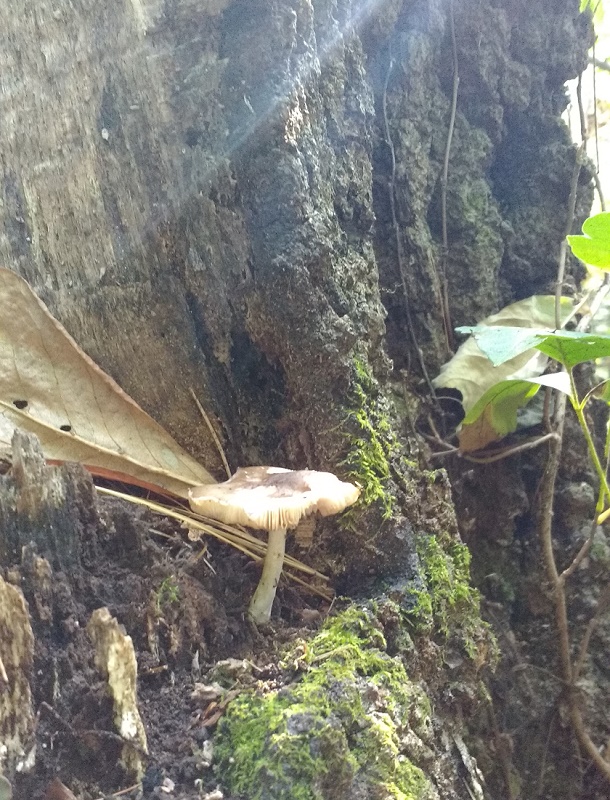
    6. Listen to the animals and sounds of nature around you. You may hear human-made sounds and that is ok. Just let those fall away and tune back into the sounds of nature.
    7. Not as a goal, but as an aide in reflecting, notice the different sounds of nature you hear: the different bird calls, the sound of a squirrel, the rustling of leaves, the bark of a dog.
    8. Notice your breathing as you notice the sounds of nature around you. Try to keep your breathing steady and slow.

    (If you are not doing #5, here’s your reminder!)

    • Notice what you physically feel: do you feel a slight wind on your skin? Is it cold? Do you feel the warmth of your coat?
    • Notice what you smell: do you smell the leaves that have fallen? Do you smell the fire from a neighbor’s fireplace?

    This activity doesn’t need to be time-consuming. Five to ten minutes is fine. However, you may find like I did that once you do this activity a few times, you will enjoy longer time spent reflecting in silence.
  • Fantastic Finds from My Corner

    Fantastic Finds from My Corner

    by Elizabeth Pass, Cohort VI
    for the September 2022 issue of Headwaters Highlights

    September. This month brings with it the promise of wonderful things coming:

    • a riot of yellows and golds, and oranges, and reds
    • crisp days perfect for your favorite sweater
    • homemade apple cider, hot or cold it’s tasty
    • watching backyard friends store for the winter

    And I’m sure you can think of many more wonderful things you look forward to each fall. Here are a few favorite finds I’ve come across that I hope you can use!

    Nature & Environmental Blogs & Websites

    Here are some of the best nature and environmental blogs and websites for 2022. Browse at your leisure and find the ones you prefer.

    12 Best Environmental Websites and Blogs 2022

    100 Best Environmental Blogs and Websites to Follow in 2022

    100 Best Nature Blogs and Websites to Follow in 2022

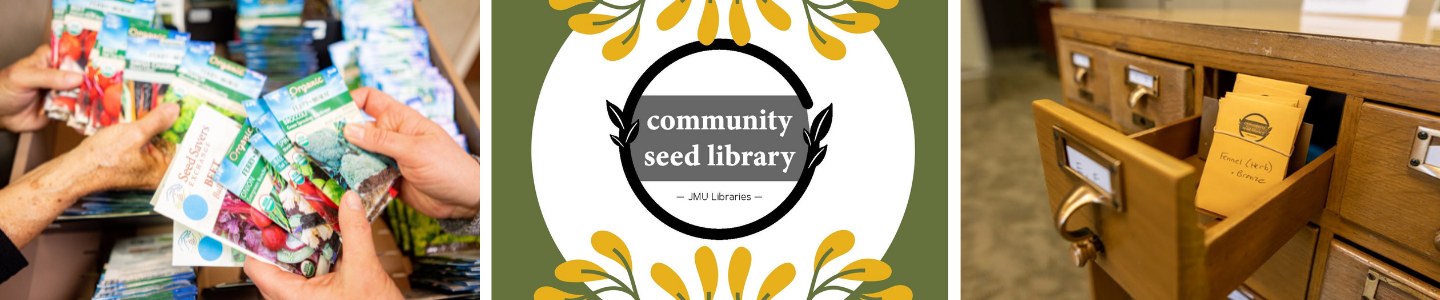
    Image from JMU’s Community Seed Library webpage.

    Seed Library

    As I was rummaging around online in the JMU Library, I came across the Community Seed Library. Huh?! As the page states, “The Community Seed Library is a self-service seed sharing library provided by JMU Libraries and available to all. No library card necessary!”

    The Community Seed Library is located at Carrier at JMU, the cabinet in the Main Lobby (to the right of the Service Desk). It is also at the Massanutten Library (Central Branch), the cabinet on the 2nd floor next to the Reference Desk (past the Children’s Section).

    Check out this great find! There is an explanation of How It Works, great information on Seed Saving & Gardening Resources, and links to other Local Organizations.

    – Elizabeth Pass, Cohort VI, for the September 2022 edition of Headwaters Highlights

  • Fantastic Finds from My Corner

    Fantastic Finds from My Corner

    by Elizabeth Pass, Cohort VI
    for the August 2022 issue of Headwaters Highlights

    August has always been an odd month for me. It feels like it’s a neither-nor month: it’s neither summer nor fall. It’s still hot—and depending on where in the US you are, it can be the hottest month of the year—but it’s the month that signals the beginning of Fall. Stores are stocking and advertising back-to-school merchandise and specials; farmers are getting ready for harvest season; teachers are preparing in earnest for their classes; students are returning or organizing to go back to school. I’m even beginning to see the squirrels start their annual burying of nuts all over my backyard.

    To make up for my neither-nor attitude toward August, I’m offering a couple of the most interesting finds I’ve seen in a while.

    Rocks, Rocks, Rocks

    Most of us are familiar with various flora, fauna, and wildlife apps and probably use many of them. However, we may not be as familiar with the rock, crystal, and mineral apps. In an article by Rock Seeker, “Best Rock and Mineral Identification App for 2022,” he reviews and lists the Pros and Cons of what he considers the best apps of 2022 for rocks and minerals. I’ve given a brief annotation for each app. Search on your phone in your Apps for the one (or ones!) you want.

    Smart Geology – Mineral Guide, Best free app for minerals; easy to use; easy interface

    Minerals guide: Rocks, Crystals & Gemstones, Advanced search functions (autocomplete, voice search); can work offline; also provides definitions, characteristics, and examples

    Geology Rocks – Handbooks of Rocks, Great for researching and learning about rocks and minerals once you already know what they are

    Geology Toolkit Premium, This app has a cost to download—$7—but is certainly worth it. More than a rock and mineral identification app, although it’s fantastic for that. It’s a large resource of information for rocks, minerals, and even fossils!

    Stone – Crystal Identification App, Very clean, minimal user interface; great images but gives no names so it’s great for learning to identify crystals and practice crystal identification by sight


    Birds, Birds, Birds

    The Audubon website is so large that it’s hard to grasp all the information it has.

    Here are two interesting items on the site about climate change and its effect on birds:

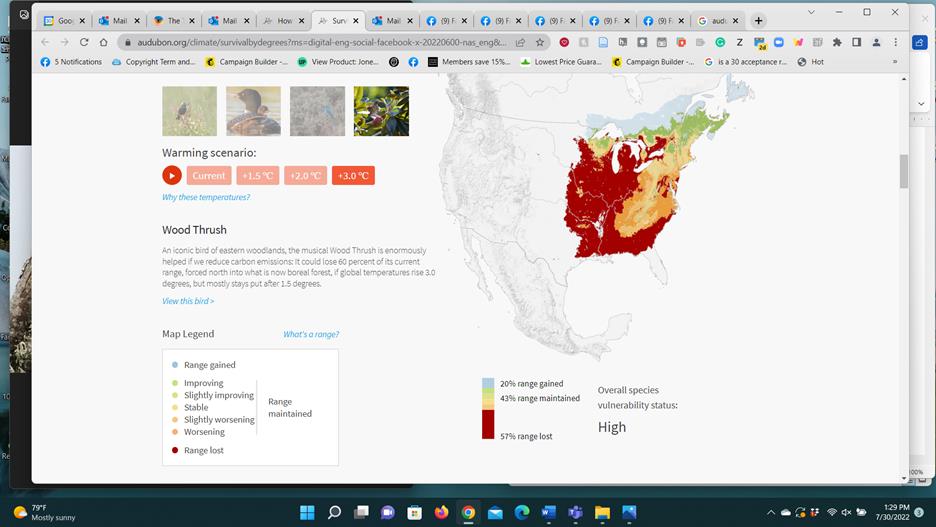
    Screenshot from Audubon.org by Elizabeth Pass, July 30, 2022

    Survival By Degrees: 389 Bird Species on the Brink – Thanks to 140 million observations from Audubon scientists, other scientists, and birders, we can see how climate change and humans impact each species’ range. And as they report on their site, “Birds will be forced to relocate to find favorable homes. And they may not survive.” The model shows specific species at three different temperature scenarios, and during different seasons.

    Also on this page, you can search their “Bird and Climate Visualizer” by bird species, state, zip code, temperature and/or season.

    Screenshot from Audubon.org website, August 1, 2022. Chipping Sparrow, Photo by Roger Baker/Audubon Photography Awards

    Find the information on Virginia here: How Climate Change Will Affect Virginia’s Birds

    – Elizabeth Pass, Cohort VI, July 2022

  • Fantastic Finds from My Corner

    Fantastic Finds from My Corner

    by Elizabeth Pass, Cohort VI
    for the July 2022 issue of Headwaters Highlights

    Welcome to July! Farmers’ Markets, backyard BBQs, fresh lemonade, and lazy afternoons under any shade you can find. Everything is blooming and buzzing so this month I want to share a couple of finds focusing on smells and sounds. 

    July Is for Smells

    In Revelations in Air: A Guidebook to Smell, Jude Stewart states that “Learning to smell is all about noticing — tuning into an often-neglected sense that surrounds us daily.” In her book, she offers great ideas to tune into our smell.

    Create a smell journal. Creating a smell journal doesn’t have to be fancy if you aren’t fond of journaling. It can be a text doc on your phone, a daily note in a Notes app, or a quick jot on a paper calendar.

    The goal is to notice one smell daily and jot down some observations about that smell, don’t just identify the smell but describe it. For the author of Revelations in Air, this exercise gave an expected and unexpected benefit. Stewart states, “The expected benefit was what I was aiming for: It heightened my awareness of everyday smells. If you’re trying to notice just one smell every day, you will inevitably notice more than one . . . .  Now for the unexpected benefit: noticing smells is a really emotionally evocative way to journal, period. Paging back through smell entries, you can’t help but remember other aspects of those days, the weather, the texture of the day, etc.”

    Compare similar smells. If you want less commitment over time, this idea is interesting. Pull together several similar smells and compare them. For example, if you like to cook and have several types of a similar spice or seasoning/item (e.g., salt), take a pinch of each and put them in separate small bowls or spoons, and then sniff them in turn. At the first pass, they may smell similar but then you will start to notice differences among them. Stewart suggests to, “Take a minute to study those differences, then maybe test your knowledge blindfolded with a friend. This exercise built my confidence that I could actually improve at smelling.” 

    July Is for Sounds 

    I found two wonderful sites to listen to and also that you can add to!

    tree.fm. I first learned of this site while reading Improvised Life and came across the article, 
    Tree.fm: Listen to Forests Around the World and Plant Some Trees
    . tree.fm is an easy-to-use site, with a Chrome extension, that lets you listen to amazing recordings of forests from all over the world. Each page has two links, Next Forest Please and Plant Some Trees. Not only can you listen to some beautiful sounds of forests but also you can do good. tree.fm has partnered with Ecosia, a search engine that uses profits from searches to plant trees where they are needed around the world.

    earth.fm. A similar site calls itself “like Spotify, but for natural soundscapes.” This non-profit site has contributors collecting natural soundscapes from all over the world, from a Black Howler Monkey in Mexico to Gulls on the Ice in Russia to the Tierra de Fuego in Argentina. As you look at the world map and click on choices or search by types to listen to, you can choose to add a sound to a playlist to create your own unique playlists. You are also able to add to the natural soundscapes.

    – Elizabeth Pass, Cohort VI, for the July 2022 edition of Headwaters Highlights

  • Fantastic Finds from My Corner

    Fantastic Finds from My Corner

    by Elizabeth Pass, Cohort VI
    for the June 2022 issue of Headwaters Highlights

    Although this month’s Fantastic Find isn’t specifically focused on Virginia, so much of its content directly apply and simply fascinates me that I want to share it with you. I hope you are also interested in this find!

    Studio d-o-t-s is a “nomadic research-led studio” that describes itself as “seeking alternative design perspectives.” They work primarily out of a van, travel all over the world, work with designers and experts from a vast variety of fields, and produce an amazing array of fascinating exhibitions, writing pieces (e. g., manifestos, articles, journals, newsletters, posters), and products.

    One of its exhibits, Plant Fever, asks its audience to discover plants’ hidden potential. They provide a variety of design opportunities for anyone to re-think and re-educate.

    The exhibit takes you through a learning path, organized into three integrated areas to consider: 1) Plants as Resources, 2) Plants as Pets, and 3) Plants as Allies. The Plant Fever Exhibition Visitors Guide, unlike most visitors guides, provides an in-depth discussion of the physical exhibition (it can be downloaded as a PDF).

    From the touring Plant Fever exhibition at CID au Grand-Hornu, Belgium, Oct 2020-July 2021. Image courtesy of Plant Fever.

    Plants as Resources asks us to view plants and our symbiotic relationship with them. The Visitors Guide then offers several specific examples and interesting facts (e.g., a discussion of the politics of seed).

    Plants as Pets was the most eye-opening concept for me. I am a passionate supporter of rescuing and adopting, in particular Chihuahuas, as proven by my current count of 6 furbaby Chis. I am also passionate about conservation and often talk to the trees, birds, and squirrels I come across, but I hadn’t equated plants—my houseplants—to my furbabies. Why not? I do believe plants communicate. Every time I smell fresh-cut grass I can’t help but envision all the little blades of grass screaming since technically that smell is released when they are damaged. What would be so odd to make the next logical step? The Visitors Guide discusses how some designers are changing the way we see plants by redesigning the homes plants live in—not the universal, standard pot but individual environments for individual needs.

    From the touring exhibition at CID au Grand-Hornu, Belgium Oct 2020-July 2021. Image courtesy of Plant Fever.

    I can’t wait to attach a magnifying glass on my ivy so I can get to know her better!

    Finally, Plants as Allies challenges humans’ vision of supremacy with recent research that suggests plants are sentient and intelligent beings. The difference, however, is that instead of using plants as a tool to solve problems, a new way to view and engage with plants is working collaboratively with plants to solve problems.

    You can watch the trailer from the Zurich exhibit. I particularly like how aware they are to provide activities for children throughout the exhibit, as well as specific activities for kids on the website!

    If you’d like to explore these topics further than what the Exhibition Visitors Guide can provide, they have written a book, Plant Fever: Towards a Phyto-centered Design. (The book is also available on Amazon.)

    Additionally, they have developed the Plant Fever message into a laminated poster manifesto,

    The Manifesto of Phyto-centered Design: An invitation to reframe our relationship with the vegetal realm, which I think is a wonderful way to start a conversation with others.

    The Manifesto of Phyto-centred Design. Image courtesy of Plant Fever.

    The manifesto has 7 items. The poster gives an explanation under each one, but I’ve only listed the 7 manifesto points here:

    1.           Plants do NOT equal Objects

    2.           Boycott monoculture

    3.           Restore the ancient alliance

    4.           Stop the war on invasives

    5.           Less is more

    6.           Leave no trace

    7.           Design with plants

    And, if you’d like to satisfy your interest even more, there is a Plant Fever Journal written by guest experts and the team of Plant Fever, as well as a #PlantNews newsletter.

    Happy exploring!

    The Plant Fever Journal homepage

    – Elizabeth Pass, Cohort VI, for the June 2022 edition of Headwaters Highlights