Category: Virginia Bird & Wildlife Trail

  • Warblers and Wildflowers

    Warblers and Wildflowers

    Spend Time with Mother Nature on Shenandoah Mountain

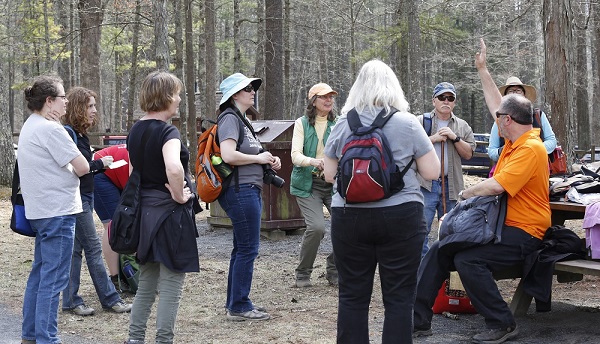
    Friends of Shenandoah Mountain and Headwaters Master Naturalists are joining forces to encourage members of the public to discover the springtime treasures found on Shenandoah Mountain. Over past years, we’ve hosted Wildflower Walks on Shenandoah Mountain. This year, it will look a little different.

    On Saturday, May 8 from 10AM to 2PM, three sites along the Virginia Department of Wildlife Resources’ Bird and Wildlife Trail will be prepared for visitors with nature experts and activities to help them explore these areas.


    Virginia Bird and Wildlife Trail Sites
    ​
    Visit as many of these sites as you like: 

    • Hone Quarry – Meet at Picnic Area, walk along native trout stream, view birds and wildflowers, tadpoles, hemlock forest, wheelchair accessible (more info and directions). Watch for potholes in paved Forest Service access road. 
    • Braley Pond – Meet at Picnic Area, take 1/2 mile hike around beautiful pond, view birds, wildflowers, salamanders and tadpoles (more info and directions)
    • Shenandoah Mountain Crest on Rt. 250  – Scenic view of Highland County, walking tour of  Confederate Breast Works with interpretive signs,  birds, history of Ramseys Draft Wilderness and Shenandoah Mountain (more info and  directions)

    More information about this event on the Friends of Shenandoah Mountain website HERE.

    From Sandy Greene who has been helping to organize this event:

    “As COVID vaccinations increase and restrictions begin to be lifted, Headwaters Chapter is planning a socially distanced twist on the previous successful Wildflower Walks on Shenandoah Mountain, with thanks to Chip for organizing those in partnership with Friends of Shenandoah Mountain for so many years. We are also blending our monitoring commitment to the Bird and Wildlife Trails, by featuring three sites that have restroom and parking capacity: Hone Quarry, Braley Pond, and Shenandoah Mountain at the Confederate Breastworks. 

    Public visitors will be encouraged to explore on their own, supported by a team of four volunteers at each site. (These teams include a “Greeter/Coordinator,” “Scout,” “Kid Activator” and “Expert.”) Volunteers come first from current Bird and Wildlife Trail monitors, and other Master Naturalists with ties to these sites and loops, as well as US Forest Service Biologists, who have also participated in Wildflower Walks in the past. These teams have already come together, but we welcome HMN participants and visitors. We will be keeping lists of wildflowers and birds, especially warblers, and will encourage the posting of those sightings and photographs to eBird and iNaturalist.”

    Greeter/Coordinators: 

    • Braley Pond:  Sandy Greene
    • Hone Quarry:  Cheryl Shull
    • Shenandoah Mountain:  Lynn Cameron

    HMNs who do not have active volunteer roles in this event are still welcome and encouraged to come by these sites to participate and/or lend a hand to make this a fun and rewarding experience for everyone attending! No registration needed!

    This event has been approved for up to 1.5 hours of CE credit for HMNs who attend. Note: Log CE hours for this activity into “Continuing Education activity” and not “VOL: Warblers & Wildflowers.”
  • Along the Lost Shoe Loop

    Along the Lost Shoe Loop

    jasonhallacher-lostshoe-10-20-18-sg.jpg

    On Saturday, October 20, members of the 2018 HMN Basic Training class explored three sites along the Lost Shoe Loop of the VDGIF Virginia Bird & Wildlife Trail. Class member Lisa Klein describes the morning at Lake Shenandoah below. Lunch and a walk followed at Grand Caverns. The trip concluded with a look at Madison Run.

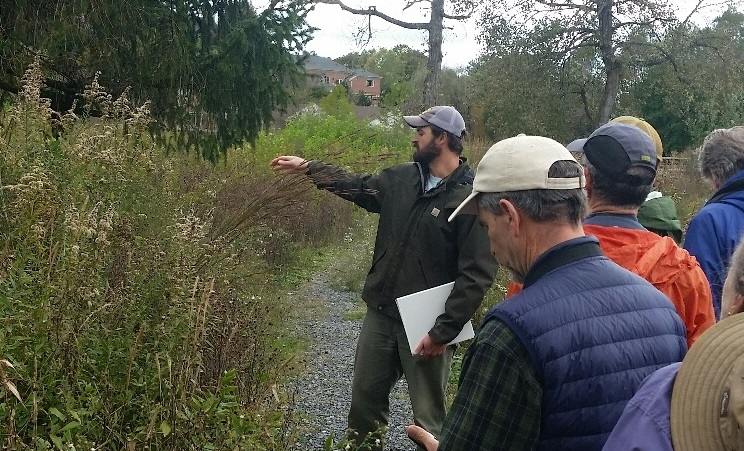
    Twelve enthusiastic members of the current Master Naturalist class met with VDGIF Biologist, Jason Hallacher, to explore the pollinator path at Lake Shenandoah. Jason was instrumental in creating the path and he shared his knowledge and care of the area.

    We walked along Lake Shenandoah, starting with the pollinator meadow. Jason talked about the challenges of working with local neighbors, some of whom preferred a neat and tidy lawn. When preparing the land to create the meadow, it was necessary to kill the grass and then plant the seeds that would create a habitat for butterflies, hummingbirds, and other wildlife. There was some discussion of the use of herbicides and the pros and cons of its use in restoring an area to native plants. Grass roots are so difficult to remove that in order to create the meadow in a reasonable time frame, herbicide was necessary to expedite the process.  Jason said that it was possible to kill grass with large amounts of black plastic, but that would take up to two growing seasons to effectively prepare the ground for native plantings. The meadow’s plants were tall and full of seed heads. We did not see any hummingbirds (they had already flown south); there were a few Monarchs and goldfinches, mallards and a kingfisher.

    There were bird watchers in the group who spotted coots on the lake as well as a great blue heron who was fishing near a beaver lodge. Unfortunately we did not see any beavers, but Jason assured us that there were several. He said that beavers were not introduced, but had arrived on their own as young adult beavers that left their parents’ lodges and found new places to live.

    We did not walk as far as planned because there was so much to look at along the trail. Jason pointed out which plants were native and discussed invasive species.  Jason did an amazing job of explaining the area around Lake Shenandoah. Many of the participants plan to return to the lake.

    – Lisa Klein, Cohort VI, October 2018

    Top photo is by Sandy Greene. VDGIF biologist Jason Hallacher is leading the group along the pollinator trail at Lake Shenandoah.

    Photos below by Lisa Klein. Click on them for better viewing.


  • Silver Lake – VBWT Site Spotlight

    Silver Lake – VBWT Site Spotlight

    silverlake

    The Virginia Birding and Wildlife Trail Adoption project is currently among the most popular for Headwaters Chapter members. About 20 of our members are doing work as trail adopters, helping to monitor sites on two of the three loops in our region (The North River Trail and Forest Trail). The VBWT project is definitely high on my list of favorites for my own volunteer time—it’s like getting paid (in recordable volunteer hours) for what you’d be doing anyhow—hanging out in beautiful spots and looking at plants and animals. On the last Saturday in August, I made my summer season visit to my VBWT site, Silver Lake, just outside of Dayton, VA.

    Silver Lake is a beautiful and extremely accessible gem of a spot just outside of Harrisonburg, and if you haven’t already been there, I highly recommend it for a quick stop to soak up some of the beauties of the natural world.  There’s easy parking (just a matter of pulling off on a generous shoulder on Silver Lake Road, right on the shore of the lake) and a trip there is pretty much guaranteed to be rewarded with sighting something exciting. Usually, when I make my trail adoption visit, I’m focusing primarily on birds, but the summer season is special—that’s when the dragonflies are on the prowl.

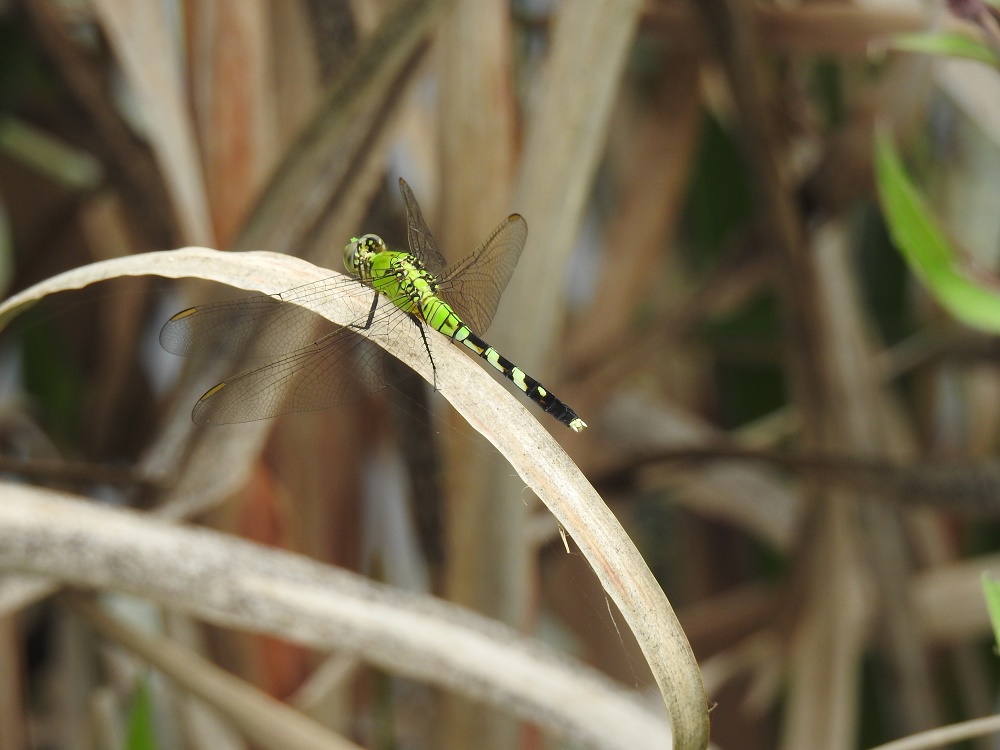
    Eastern Pondhawk.pp.crop

    There are dozens of species of dragonflies (like the female Eastern Pondhawk in the photo above) which can be found in Virginia, and I am most definitely a novice in learning how to identify them.  One of the appealing things about learning dragonflies is how closely you have to look—sometimes a correct species identification is based on pretty small differences. At the same time, though, there are enough easy species to make you feel like you’re making progress, and they’re extremely fun to look at, even when you can’t tell exactly what you’re looking at. When I was there for my Summer VBWT visit in August, I was able to identify about 10 different kinds of dragonflies and damselflies (and I freely admit to having seen others that I just wasn’t sure about). It was a good day.

    One of the things that DGIF asks of VBWT volunteers is that they post their observations on web sites like eBird or iNaturalist, helping to draw attention to the many great things you can see at these sites. eBird, as the name implies, is only for bird observations, but iNaturalist takes pretty much everything. Both of these sites are pretty accessible, and if you don’t already know how to use them, we can provide help with getting started.

    Usually when I do my VBWT visits, I go armed with a camera, and last month’s visit was no different. While an interest in taking pictures is definitely not one of the requirements for volunteering on this project, it’s a part of the work that I personally enjoy. After a trail adoption visit to Silver Lake, I usually come home, take a look at my pictures, and see what I can identify (that I couldn’t do in the field). For photos posted on iNaturalist, you can also enlist the help of the excellent community there in making identifications—I’ve had many a stranger help me with identifying a critter that I saw at Silver Lake (and, admittedly, had many a stranger correct the mis-identification that I started off with!). I’ve learned a lot there.

    night heron.ppIn August, I spent a wonderful two hours walking the perimeter of Silver Lake, taking pictures of dragonflies, listening to cicadas, trying to catch sight of the painted turtles, and watching for movement in the willow trees that might indicate the presence of a big bird.  In addition to all the dragonflies, I also saw a young black-crowned night heron (photo at right) on this visit, along with a spotted sandpiper (which I’d never seen before). I’m still regretting the frog that I missed—he jumped into the lake just as I was approaching, too quick for me to see what kind he might have been (I really like frogs and toads). There were butterflies (at least one monarch, some buckeyes, and a pearl crescent, among others), late summer wildflowers galore (ironweed, Queen Anne’s Lace), some cute little kids with fishing poles messing around with their parents on the shore, and the kind of general air of peace and righteousness that one always seems to find in such places. And I get to count that as volunteer hours.  Almost doesn’t seem fair.

    If you’re not already a part of the VBWT Adoption project, but would like to be, there are still lots of options to volunteer. We currently have 17 adoptable sites, but in the future would also like to take on the last of the three loops located in our region (Lost Shoe), so there are new adoption opportunities possible there. Site adopters are asked to visit four times a year (once per season) and make some reports on what they saw (on eBird and/or iNaturalist). I usually also pick up a little trash while I’m at Silver Lake, and DGIF also asks that volunteers report to them about problems with signage or other issues that you might find. But most of the work in volunteering for this project entails walking around in a beautiful place and looking at things. What could be better.

    If you’re a little shy about taking a site on your own, it’s also possible to partner up. Lots of the current volunteers in the project share a site, and pretty much all of them have indicated that they’d be happy to have other HMNs join in on a visit. If you’re not an expert birder, that’s okay too—it’s fine to think of volunteering for this project as a way to increase and build your skills as much as it is a way to showcase your existing prowess. If you’d like an opportunity to be part of the project, Sandy Greene and Cheryl Shull are the project coordinators (with each of them taking charge of one of our existing loops). Either of them can have you out looking at dragonflies in no time!

    – Peggy Plass, Cohort IV, Project Committee Chair, August 2017

    Dragonfly and night heron photos by Peggy. Lake photos by Adrie.


  • Cohort V Adopt-A-Trail Project Initiation

    Cohort V Adopt-A-Trail Project Initiation

    Buckhorn Inn MN Field trip (1).600

    On Saturday, March 25th, the current Headwaters Master Naturalist Training Class met at Buckhorn Inn for a scouting field trip of part of the Virginia Department of Game and Inland Fisheries Forest Trails Loop of the Virginia Birding and Wildlife Trail, which they are adopting as their class project.

    We had a chance to look around Buckhorn Inn with the owner, and learn a little of its history over 200 years as a wayside inn, gambling hall and Civil War hospital. Lynn Cameron, of Friends of Shenandoah Mountain, spoke to us on their proposal for Scenic Area designation, embedded wilderness, and multiple use, supported by many diverse stakeholders. She highlighted Shenandoah Mountain as a world biodiversity hotspot, the largest roadless area east of the Mississippi, the only dark skies designated on the east coast. She also clarified that all the current management activities and access stay the same with scenic area designation, although mining and drilling would not be permitted. We carpooled west…

    Group in Braley Pond.600

    Our first site visit was Braley Pond, where we undertook a short Bioblitz, with each person assigned a particular aspect of interest, from mosses to raptors to people and amenities. We were also all tuned in to herpetofauna, as prompted by DGIF, for inclusion in the iNaturalist Virginia Wildlife Mapping Project. Rainbow trout had recently been stocked at Braley, so there were lots of happy anglers there, armed with powerbait. Braley Pond site was the first to be adopted, by new HMN Barbara Phillips.

    We moved on to Ramsey’s Draft, where we split into three groups to honor the wilderness requirements of no more than 10 people in a group. Kate Guenther took a group on one trail to explore Bird Language. Lynn Cameron’s group was on a wildflower hunt (lots of hepatica blooming), and my group fished up macroinvertebrates (stonefly, hellgrammite, mayflies) while looking for brook trout, and attempting to “match the hatch” of caddisflies with a tied fly. No bait is allowed at Ramsey’s Draft for the native brook trout. Ramsey’s Draft has been adopted by Dave Wendelken.

    Last stop, at the top of Shenandoah Mountain, Confederate Breastworks Trail, a jaunt on the trail, with a sound map, a toast of water pure to public lands and service, a little trash picked up, and return to Buckhorn. The observation bioblitz formed the background canvas for the first monitoring of the Forest Trails Loop of the Birding and Wildlife Trail, with six of the seven sites adopted through the class so far. And this trip was a delightful day of getting to know each other better!

    Monitoring the Birding and Wildlife Trails (North River Loop, and now Forest Trails Loop), gives us an excellent opportunity to really get to know our public lands, to share the experience with others on regular monitoring trips, to get better at ID and using eBird and iNaturalist to contribute to citizen science online.

    This is the assembly of life that took a billion years to evolve… Biodiversity is the key to the maintenance of the world as we know it… it is the property that makes resilience possible…it holds the world steady… it can be eroded away fragment by fragment. – E.O. Wilson

    – Sandy Greene, Cohort I, March 2017

    All photos by Deb Pugh, Cohort V

    Photo at top is of Jan Worthy on the porch of Buckhorn Inn. Second photo above is of group gathered at Braley Pond.

  • VBWT Adopt-A-Trail Phase II

    VBWT Adopt-A-Trail Phase II

    In addition to the updates below, HMN Coordinator for this project, Sandy Greene, has compiled some tips for successful monitoring trips here: DGIF Birding and Wildlife Trails for HMNs

    Adapted from an email sent to Adopt-A-Trail Project coordinators by VDGIF’s Virginia Birding & Wildlife Trail Project organizer Jessica Ruthenberg on March 30, 2017:

    SwitzerLakeJuly2016.cropWelcome Spring and a New Year of the Adopt-A-Trail Project!

    Announcements

    • For those chapters who participated in the Adopt-A-Trail project during 2016, you no longer need to submit last year’s, Phase I checklist form for this year’s monitoring efforts! Instead, you will now be using the Phase II instructions sheet here: VBWT_PhaseII_SiteReVisit Instructions_updated033017. These instructions will soon be available for download from the VMN website: http://www.virginiamasternaturalist.org/virginia-birding-and-wildlife-trail-adoption.html

    • If your chapter is new to the Adopt-A-Trail project for 2017- OR-have participated in the past, but have adopted a new loop for 2017, please use the Phase I site visit checklist forms for your monitoring and submit those in a group back to me at the end of the spring season. Keep in mind that spring can be a very busy time of year for park and public land managers, so it may be a difficult time of year to get ahold of site contacts. You may have better luck contacting them in the fall or winter seasons; it’s ok if you are not able to complete that part of the checklist this spring season; you can try for that part later down the road. The contacting of site contacts (managers/ owners) is a ONCE/ YEAR task. Once you chapter has completed all the items on the Phase I checklist, including contacting site managers, you may move on to using the Phase II instructions sheet. If you have any questions about the checklist forms, please feel free to contact me.

    • Be Aware of Hunting Seasons – Virginia hunting seasons take place April 1 – May 31st and Sept. 1 – Feb. 28th. During these timeframes, hunting may occur any day except on Sundays when on public lands where hunting is permissible. If you have any Wildlife Management Areas (WMAs) on your adopted loop, please take this into consideration when timing your site visits. Wearing blaze orange is recommended for safety during these time periods. You also may want to consider conducting your WMA visit on a Sunday during these timeframes. Keep in mind that hunting does also occur at some state parks and national wildlife refuges, so you may want to check with those locations about whether/ when hunting may be occurring during these seasons.

    • A note on VBWT signage maintenance –Please do not attempt to maintain/ replace VBWT signage on your own. The large directional VBWT signs with arrows on roadways may only be replaced/ maintained/ removed by Virginia Dept of Transportation (VDOT). Even at DGIF, we must work with VDOT to maintain/ replace/ remove these signs. Similarly, the smaller VBWT signs at site entrances & kiosks should really only be maintained by the site itself, as it is on their property. Please do not attempt to maintain/ replace/ remove them on your own without first seeking out permission of the site owner/ manager.

    New project materials available!

    • In addition to the “Phase II Site Re-visit Instructions” which will be available shortly, “Guidelines and Tips for Adopt-A-Trail Chapter Coordinators” is now available for download from the VMN website at http://www.virginiamasternaturalist.org/virginia-birding-and-wildlife-trail-adoption.html. This document will be very useful for new chapter coordinators just starting out or for any coordinators looking for tips/ advice from other chapters.

    Project Status Report

    • Webpage Updates – Updates to site description webpages based on the information provided in 2016 checklists is in progress. Updates are being made one loop at a time. You will be contacted when updates to your loop’s webpages have been completed. Your patience with these webpage updates is very much appreciated!

    • Replacement Signage – Many chapters have indicated needs for replacement signage. We thank you for providing this information! All signage replacement needs have been documented. Replacement signs will be provided, however this will take some time to accomplish. Due to a limited supply in our current stock, budgeting processes for a reorder, and the multiple players involved in getting the new signs posted, it could be quite a while before you see replacements made. However, please know that they are very much on our radar and we do intend to make the replacements. Your patience with the process is much appreciated.

    Year-end Survey Results from 2016

    • Thank you to all the coordinators who submitted the 2016 End-of-Year Survey Report Form. Your responses and feedback has been much appreciated! The response you provided inspired and helped to create the new “Guidelines and Tips for Chapter Coordinators” document, were incorporated into the new Phase II instructions sheet, and will continue to provide valuable insights/ feedback as we continue to work on improving/ maintaining the VBWT as well as the Adopt-A-Trail project! Thanks again!

    • A summary of these survey results is here: Adopt-A-Trail Year-end Survey Results_2016. It includes a few responses (in blue) to address the project challenges expressed, which I hope you will find helpful.

    Looking forward to continue working with you all this year! Keep up the good work!! As always if there are questions or concerns regarding the project, please feel free to contact me.

    Best,
    Jessica Ruthenberg
    Watchable Wildlife Biologist
    Virginia Department of Game & Inland Fisheries
    3909 Airline Blvd., Chesapeake, Virginia 23321
    Office: (757) 465-6868 • Cell: (804) 229-2556
    jessica.ruthenberg [at] dgif.virginia.gov

    Top photo is from Switzer Lake, July 2016, VBWT site on the North River Loop.