Vicki Langdon is among our newest Chapter members, having transferred in from another chapter and currently living in the Harrisonburg area. Stephanie Gardner, with our Chapter’s Newsletter Team, was recently in touch with her to find out a little bit about her and help introduce her to other members:
Welcome to Headwaters Master Naturalists, Vicki!
Thanks for helping us get to know you through this online interview.
From what chapter are you transferring your VMN membership?
Rockbridge Master Naturalist Chapter
How long have you been involved in the Virginia Master Naturalists program?
Unfortunately the chapter dissolved within a year or two of my completing the course.
What were some of your favorite past volunteer and leadership projects with VMN?
Because the chapter dissolved, I took the Master Gardener Course and have been an active member of the Rockbridge Master Gardener chapter over a number of years.
In what areas will you continue to volunteer or are looking forward to exploring?
I look forward to volunteering with many of the numerous offerings with the HMN chapter and look forward to participating in this active chapter.
Please tell us about other interests and hobbies that you enjoy.
Gardening is a favorite interest along with music, singing with the local Shenandoah Choral Society, traveling.
Rob Beaton writing down observations on the habitat and organisms that live in a vernal pool.
Maple Flat Ponds
Each spring, as wood frogs and salamanders across Virginia make their way to vernal pools, so too do avid Vernal Pool Monitors. This presented an opportunity for me to connect with an extraordinary citizen scientist and Master Naturalist by the name of John Holden. If you ever get a chance to attend a hike, wildflower walk or numerous other guided outings led by John, do yourself a favor and your life will be enriched for doing so.
It was a cool 41-degree sun filled morning and my mission was to meet up with John at the Maple Flats Vernal Pools in George Washington National Forest. The pools are located in southeastern Augusta County and are largely on U.S. Forest Service property and encompass 272.8 hectares. It is home to a wide array of flora and fauna that will surely sidetrack you from your original mission as it easily did me. John has monitored these specific pools for more than 10 years and has clearly immersed himself in the surrounding area as he frequently gives tours/talks to students and other groups on wildflowers, butterflies and numerous other native species that reside in this area.
Our day started off with a 30-minute informal training and informational session on the seasonal pools and the ecological services provided by the pools. This session contained numerous handouts, guides, maps and equipment that he considered necessary for a new vernal pool student to be successful in becoming a monitor in the future.
These sinkhole ponds are unique to the western base of the Blue Ridge in our area and form when limestone dissolves locally beneath a mantle of colluvial soils which washed off the mountains. A layer of clay forms several feet below the surface of this area and creates a perched surface water table that reaches up into the sinkholes during the wet season. Due to different hydrologys, some of the sinkhole ponds may have ground water connections, while others fill from surface runoff. They start to fill with water in late fall, then dry up in the summer. Since they are not permanent, fish cannot survive in them. This is significant for many species of amphibians as fish can eat their eggs and larvae.
Recently hatched salamander egg masses.
On this day, we set out to survey and monitor five of the thirteen pools and wetland areas John monitors. Our mission for the day was to observe the various life stages of seasonal pool indicator species. Specifically, three species of Salamanders, the Spotted, Marbled and Eastern Tiger Salamanders and other vernal pool residents such as the Fairy Shrimp, Wood Frog and other indicator species. Our search mostly resulted in the egg masses and older larvae of the Spotted Salamander. In one specific pond, we were excited to observe over 40, mostly Spotted Salamander, egg masses that appeared to be already hatched out. The number of hatchlings observed confirmed this and John seemed happy with the results.
At left: John Holden observing a Red Backed Salamander. At right: A Red Spotted Eft.
Though we did not find any adult salamanders, not due to a lack of turning rocks and logs on our part, the invaluable training, education and stories presented by John were enough to fill those gaps. I did however, find a few Red Spotted Efts and Red Backed Salamanders. Though not our target, they were a first find for me.
We completed our trip with an out-brief and John presented me with some further information and an invitation for anyone in the HMN Chapter who is interested to attend another guided training event at the Maple Flat Vernal Pools. While volunteers like John work to verify potential vernal pools as part of the mapping project, repeated monitoring of known pools is essential to establish a baseline of data with which to compare future changes, and to increase our body of knowledge about these unique wetlands. The success of this project depends on committed volunteers who will visit “adopted” pools a few times each year to assess biological and physical metrics. A day well spent and a new friend made.
by Elizabeth Pass, Cohort VI for the April 2023 issue of Headwaters Highlights
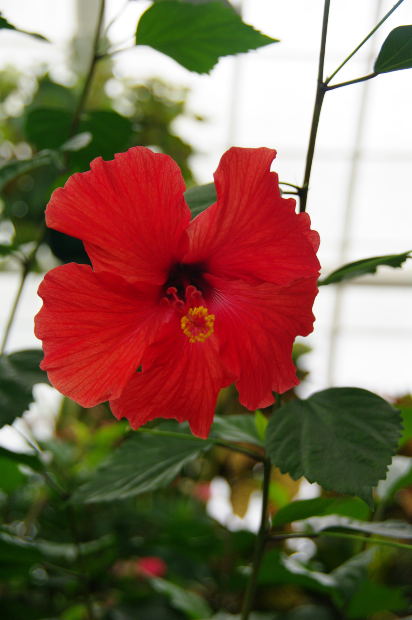
As Spring comes into full bloom, I think of my recently passed aunt who lived in Albuquerque. Every morning from early spring to late fall she would sit with her coffee on the back patio in the same chair, which was next to a potted hibiscus plant. She would sit for several hours, not reading, writing, or doing anything but sitting and slowly drinking her coffee.
When I was visiting my aunt and uncle one summer, I noticed this repeated activity of hers and asked about it. She told me that every morning she watched her hibiscus plant open. Hibiscus flowers open and close with the sun every day (nyctinasty). She loved how beautiful the flower was, and was amazed that it opened at such a speed that she could watch the flower unfold. For her, it was as if she got to watch the miracle of life every morning.
I thought about it and realized that I also did a similar activity every day. Since COVID, I’ve worked more at home. I would work in the same place every day: on a couch with my laptop next to a large window. As I sit and work on my laptop, I look out the window and see my neighbor’s second-floor backyard roof, downspout, and beyond that, large evergreen trees. Every day throughout the day as I work, I look out the window and watch squirrels run around the roof, drink out of the downspout, and chase each other through the trees.
Like my aunt, being able to connect with nature at the same time and same place gives me a sense of grounding and a feeling of awesomeness in this great web of life.
I encourage you to look at the daily activities you consistently repeat, for example, drinking coffee/tea, reading the news, meditating, or walking your dog. Find an activity you know you will do daily (or almost daily) that will put you where you see the same view of nature or puts you in the same natural environment. You may already do this daily activity within this view of nature (as I do), but the idea is to become aware (as I did after watching and talking to my aunt), to live in its presence each day while you do your activity. I hope you find an activity coupled with nature and begin to see the rewards of connecting the two. Welcome in Spring!
– Elizabeth Pass, Cohort VI, for the April 2023 edition of Headwaters Highlights
Jay Landis at the telescope with Zack Perdue at Starry Meadows Farm. Photo by Sharon Landis.
Headwaters members are treated to guided star gazing of the early spring sky
On March 26, 2023, Zack Perdue led a stargazing party at Starry Meadows Farm in Linville. Sadly, this event had to be postponed due to cloud cover earlier in the week, so only four Headwaters members could come. The sky this night was clear and beautiful! Venus put on a show. So did the crescent moon. The bright moon did hinder some of our views, as even the Milky Way was not visible.
We were able to see quite a few constellations: Andromeda, Orion, Cassiopeia, Canis Major with Sirius the Dog Star, Pleiades, Ursa Major, Ursa Minor, and even Mars with the naked eye and binoculars. Seeing the moon through a telescope with a moon filter lens was really a treat! We all enjoyed using binoculars and Zack’s refracting telescope. We saw a reddish tint to Mars and that Sirius was bluer than Mars. Blue stars are younger and hotter stars. I learned that Cassiopeia is a constellation in the Milky Way, and how to use the moon to find Pleiades, Aldebaran, the fiery eye of Taurus the Bull, and Mars.
We especially enjoyed seeing images on our own phones connected by Wi-Fi to Zack’s EvScope, a telescopic camera that can take very long exposures.
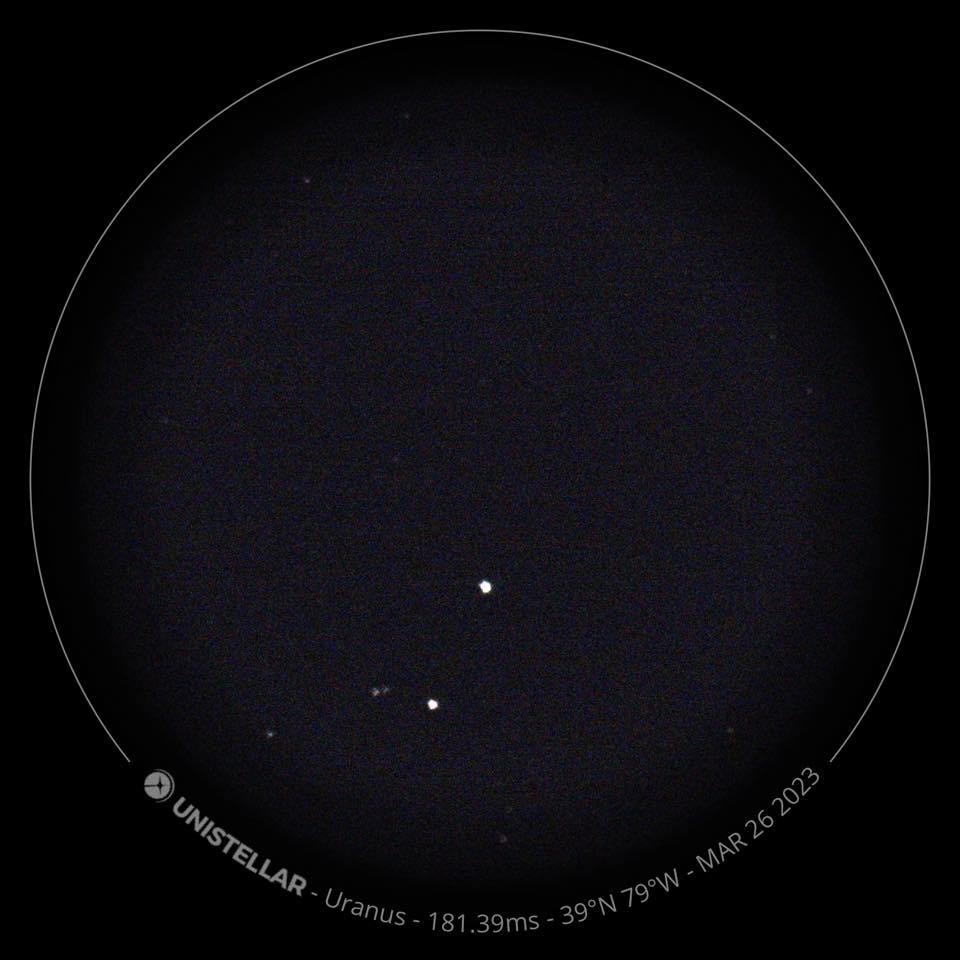
Using the EvScope we saw Sirius (so cool!), M42- Great Nebula in Orion, Uranus, M51-Whirlpool Galaxy, M1 Crab Nebula, and M46- an open cluster of stars with a planetary nebula in the middle! (A planetary nebula is not related to planets but is a cloud of gas shed from red giant stars late in their lives.)
Zack told us the “M” stands for Charles Messier, a French comet hunter. The Messier Catalogue might be the most famous astronomy catalog, detailing deep-sky objects such as galaxies, globular clusters, and nebulae. It includes some of the best objects to see in the night sky with a telescope. But the Messier Catalogue didn’t start out as a list of desirable astronomical objects: rather, it was Messier’s record of targets to avoid in the night sky since he was chiefly interested in comets.
Sharon Landis, Cohort VII, March 2023
All photos by Sharon.
Click on an image to start a slide show with captions. Thanks to Sharon for these great labeled shots and Zack for his expertise and cool equipment!
Shenandoah National Park Thornton Gap entrance planters
Learn about a unique volunteer opportunity at Shenandoah National Park, thanks to Jerry Hopkins!
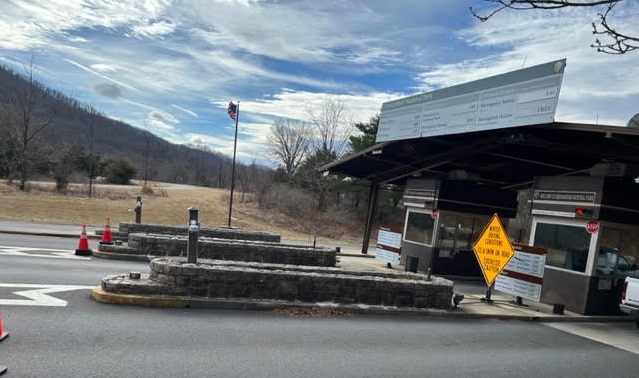
Shenandoah National Park [SNP] has four wildflower planters along the 105 mile Skyline Drive. One is located near the north entrance [Front Royal] at Dickey Ridge Visitors Center; one is at the entrance station at Thornton Gap; one is at the Big Meadows Visitors Center; and the fourth is at the entrance station at Rockfish Gap.
The purpose of these planters is to showcase some of the wildflowers native to the SNP and to help educate the visitors of the different flowers and the pollinators they attract. Many visitors are unable to see wildflowers up close and this provides them the opportunity.
I volunteer to help with the Thornton Gap planters, along with seven other individuals, at the Thornton Gap Entrance Station. This is located at the intersection of Route 211 and the Skyline Drive. Rt 211 was built before the revolutionary war and was graveled before the Civil War thus providing better crossing of the mountains by both armies. The colony of Virginia had the road built in 1746 to provide a route for farmers in the valley to access Mr. Thornton’s mill in Sperryville. Francis Thornton built a mansion similar to Mount Vernon with its huge columns and his home can still be seen [not open to visitation] driving Rt 231 from Sperryville.
The wildflower planters are constructed of stone in the same manner as the stone walls that were built by the Civilian Conservation Corps lining most of Skyline Drive. Volunteers provide all of the upkeep to the planters throughout the Park. The season starts in April when the beds are cleaned and plant ID labels are inserted. New plants may have to be added and some plants may have to be removed. The replacement plants are propagated by the Park at the Luray Headquarters. To help conserve moisture the beds are mulched. Last year we were able to add soaker hoses to provide drip irrigation to the planters at Thornton Gap. Because these planters are in full sun and absorb the heat from the stone walls and the asphalt drive, they tend to dry out quickly in the summer. The soaker hoses are meant to be kept in the planters year-around and are covered by mulch which helps keep the moisture in the planters longer and cover any unsightly hose. Throughout the growing season there is maintenance to be done such as deadheading spent blooms, removing weeds, fertilizing, and cutting plants to a certain height. Each planter location in the Park has its own requirement for plants.
At Thornton Gap, plants have to be kept at a certain height so as not to block security cameras that cover the Entrance Station. This prevents these planters from having the taller wildflowers such as the Joe Pye Weed, Milkweed and Cow Parsnip. The plants are arranged so that there is always some blooming types through the growing season.
Later this month, around March 19, the swallows will return to San Juan Capistrano, California, from their wintering grounds 6,000 miles away in Argentina. In early April, swallows will also return to Thornton Gap. These swallows have a longer journey to reach Thornton Gap where they will nest to rear their young. They have their nests in the Entrance Station roof. It is always exciting to witness their return and to hear all the noise that over 100+ birds can make flying around the visitor entrance area. It is a mixed blessing to those visitors who may enter the entrance area in convertibles with the top down and for the Park Entrance Staff as they have to hose down their windows each day until the swallows start their long migration back to South America. This is the only area in the Park that I know of where swallows nest. They are able to meet their big three at Thornton Gap: shelter; food [there is no dearth of insects flying around]; and, water [an underground spring next to the entrance station has water bubbling to the surface that provides year-round water]. All of the luxuries of home so close to the nest! Sometime in the fall, in September or October, they will gather in a large swirl and all of the families will be gone at one time, heading south. One day they are here and the next they are all gone until next year. A void when they go as you know cold weather is coming soon and it is now time to start the wintering process of the wildflower planters.
Wintering the planters consists of making them visibly pleasant to the fall and winter visitors. This means cutting the plants to about an inch high, removing all plant debris, removing plant ID tags and fertilizing and mulching for the winter. The drip hoses are kept in place, hidden by mulch and the maintaince tools are cleaned and put away in the storage area for the winter.
The Park is always looking for volunteers to help with these planters. The Park provides you with a uniform and safety equipment [gloves, safety vest and safety glasses]. The uniform is required at any time you are working on the planters. Many visitors will stop to ask you questions recognizing you as a representative of the Park. If someone has an interest in volunteering at any of the four planter locations for the April through early November season they should contact me by text or phone [540-383-1079] or by email [gerald.hopkins [at] comcast.net]. Time requirements would mean one trip to the planter each month. It may require a three hour stay each time you go depending on need. It is fun, rewarding and educational. And it gets you close to your next hiking trail. Mary’s Rock can be seen from the entrance station and this walk provides what many experienced hikers claim is the best view in the Park!