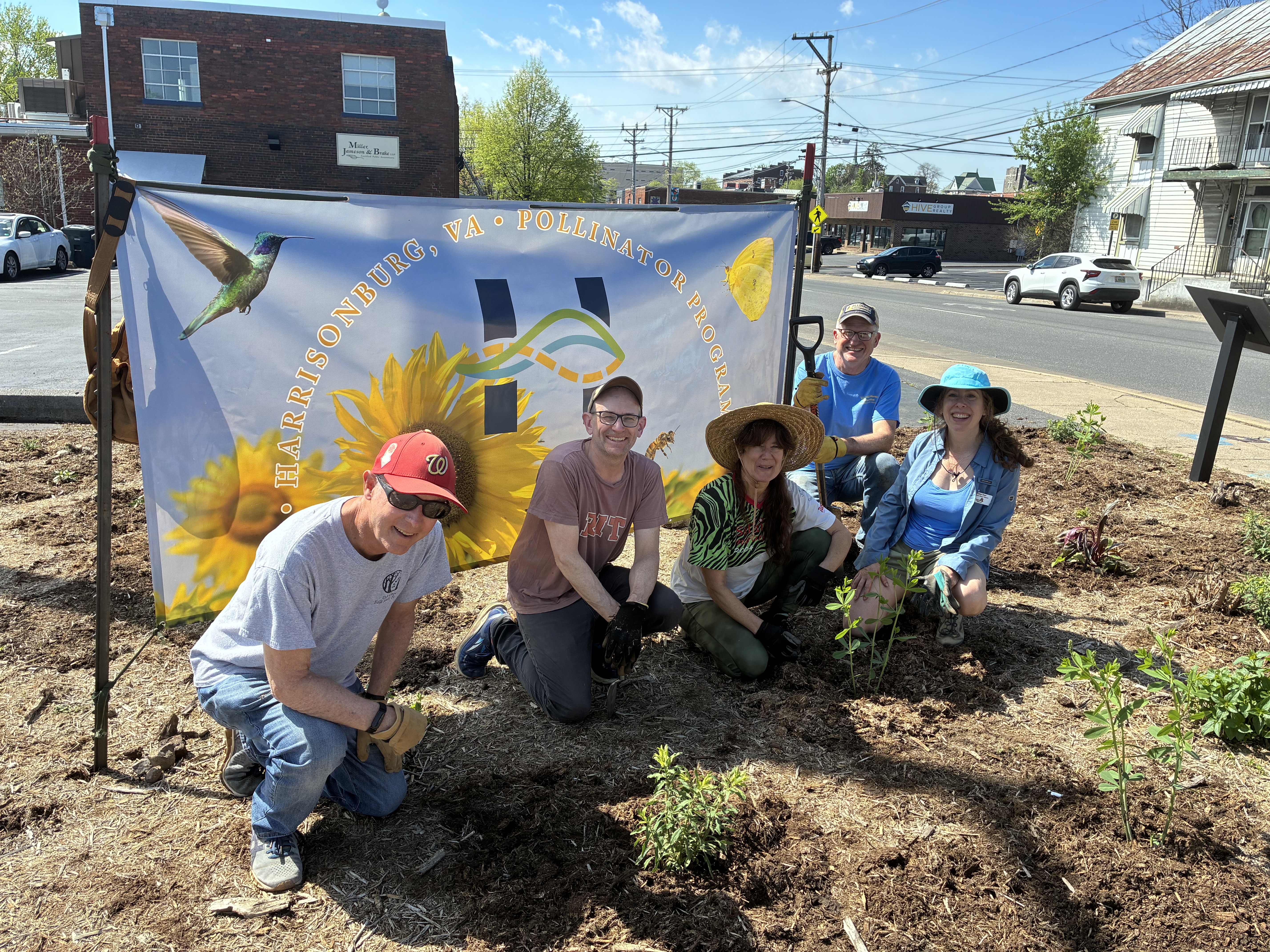
Pictured (from left): Zack Perdue, Chip Brown, Joyce Maxwell, Scott Jost, and Andrea Dono
On a beautiful Saturday morning, April 11, HMNs and community members installed around 30 native plants and weeded in the City of Harrisonburg pollinator garden on North Liberty Street across from the L&S Diner.
Through this event, and more like it in the future, we hope to demonstrate public support for Harrisonburg’s Pollinator Friendly City Program and raise awareness about the importance of pollinators and pollinator habitat on public and private property.
The next event is being planned for June, which is Pollinator Month in Harrisonburg.
Harrisonburg’s Greenspace Manager Jeremy Harold sharing about the City’s efforts to support pollinators.
CE Program at HMN Annual Meeting, 1/27/2024
As a good turnout of Headwaters Master Naturalist chapter members ate the best shared meal ever, we all were excited about the next item on the agenda: a CE presentation by Harrisonburg Public Works Department on their environmental stewardship programs using greenspace management throughout the city. No one was disappointed.
The Harrisonburg staff included Jeremy Harold, Greenspace Manager for the City, Mike Hott, Landscape Coordinator for the department and Brittany Clem-Hott, Outreach and Communication Specialist. Mike Hott discussed the city’s pollinator enhancement program. They grow their own plants for the pollinator gardens and now have two greenhouses for plant propagation. What began as a Pollinator Week celebrated each year on the 3rd week of June by the City, has now grown into a month-long celebration throughout the month of June, including a Lunch & Learn program and guided walking tours. They are working on establishing a pollinator corridor to connect public spaces along Blacks Run and elsewhere.
They already have pollinator gardens at lots of the City schools, created a pollinator labyrinth at Hillandale Park and installed pollinator gardens at Westover Park’s Gilkerson Activity Center. They provide guidance for the City’s Comprehensive Plan. They are planning a Pollinator in Your Yard event on March 23rd at the Ice House. They have a page on the Harrisonburg website and it can be reached by searching for ‘pollinator-friendly city’.
They coordinate with NRPA, the National Recreation and Parks Association. For specific plants, they save the previous year’s sunflower seeds, dry out coneflower seeds in the freezer and take cuttings from the Buttonbush.
The Urban Forestry Program has been growing for several years and they hired an Environmental Specialist position in 2017. They began a citywide program in 2018 to increase the overall tree canopy to increase shade, cool areas of the city and combat the effects of climate change as well as reduce stormwater runoff. They have three employees now and coordinate with the National Arbor Day Foundation and are now an official Tree City. The biggest challenge came when the Emerald Ash Borer began killing off many trees which had very extensive populations in places like Westover and Hillandale parks. They had to remove over 1500 white ash trees and figure out ways to put the trees to beneficial uses besides firewood and wood chips. They have offered lumber as well as firewood to the public at the Recycling Center at 2055 Beery Road and people may bid on them online. The city has used the better lumber for public space items such as planter boxes in the Water Steet alley, tables at several fire houses and a bench behind the Magpie Diner.
They have a new solar wood kiln designed by Virginia Tech students. Jeremy Harold will be offering a class through JMU’s Lifelong Learning Institute program at the Ice House on Friday mornings from February 2 to March 1.
Though they did not discuss the Harrisonburg Conservation Assistance Program for city residences and businesses, it was mentioned and Trinity Presbyterian Church just celebrated a public unveiling of their bioretention basin which was paid for with HCAP assistance. The city would like for more property owners to take advantage of this program. There is also a VCAP program for County residents.
This was one of the most informative continuing education sessions that we have had in the past couple of years. Thanks to Scott Jost and Elaine Smith for coordinating this opportunity.
Conversations abound as HMNs gather for our Annual Meeting on January 27, 2024.Photo by Carl Droms.
Making Connections at our Annual Meeting 2024
On Saturday, January 27, in the Houff Student Center at Blue Ridge Community College in Weyers Cave, the chapter came together for our much-anticipated annual meeting and potluck, transforming a routine gathering into a celebration of shared passion for nature and environmental stewardship.
A highlight of the event was the potluck, where tables overflowed with a display of homemade dishes and each contribution mirrored the diversity of the group itself.
The agenda included engaging presentations by Harrisonburg’s Greenspace Manager, Jeremy Harold. Jeremy presented Harrisonburg’s Pollinator-Friendly City and Urban Forestry programs, providing an overview of their histories, current and future initiatives, best practices, lessons learned, and opportunities for citizen support and involvement.
New board nominations were presented by President Peggy Plass and accepted by the chapter members. Welcome to the new board and Committee Chair members:
Outreach Committee Chair – Kelly Kipps
Volunteer Service Projects Committee Chair – Judy Bartlett
Membership Committee Chair – Anthony Adamovich
Secretary – Andrea Dono
Continuing Education Committee Chair – Elaine Smith (re-elected)
Newsletter and Website Committee Chair – Rob Beaton
Beyond the formalities, the gathering offered a chance for members to connect on a personal level, fostering relationships that extend beyond the annual event. Friendships were forged, and a sense of community was strengthened, contributing to the resilience and cohesiveness of the Headwaters Master Naturalists.
– Rob Beaton, Newsletter and Website Committee Chair
Click on an image below to make it bigger, see captions and start a slide show. Photos by Carl, Adrie, Elaine and Rob.
Scott making a video of bees on milkweed at Big Meadows in SNP.
Meet Scott Jost, Cohort 8!
Full name: Scott Jost
Title or occupation: I’m Professor of Art and Art Department Chair at Bridgewater College.
How long have you been a member and cohort number: Cohort 8! Began training class in Spring 2023.
*Professional Member Spotlight Questions (Choose 6)
What company or organization do you work at right now? I teach at Bridgewater College. My main area of teaching expertise is photography, and I also teach video, multimedia storytelling, and intermedia advanced studio and senior thesis classes.
Any tips or advice for new members? Go to the annual state-wide conference! As another VMN said to me in the registration line, “What could be better than spending a weekend with hundreds of nature nerds?”
What do you like most about being a member? Going through training class with Cohort 8 has been great fun—a wonderful group of people! I am also really enjoying becoming acquainted with all the other wise, wonderful, and generous HMNs who are already in the program.
Future goals and aspirations for your career? I’m 4 years out from retirement. My goals are to be the best teacher and mentor I can in these remaining years, and otherwise to serve on fewer committees and gradually become more engaged in the things I aspire to do in retirement.
What’s a project you’re working on right now? Why is it meaningful to you? I’m photographing native bees and doing some video of them, too. It’s meaningful because I am recalibrating my creative work so that it can be more directly beneficial to the conservation of nature.
*Fun Member Spotlight Questions (Choose 1)
Where are you from? Where did you go to school? I grew up in North Newton, Kansas, about 25 miles north of Wichita. I went to Newton High School, attended Bethel College in North Newton where my father taught choral music, and earned my Master of Fine Arts at the University of Minnesota in Minneapolis.
– Scott Jost
Thanks to Rob Beaton, Cohort 8, HMN Newsletter editor, for conducting this interviewfor the February 2024 editionof Headwaters Highlights.
Cover art for Stephanie’s book, “Rattlesnake Granny.” Photo courtesy of Stephanie.
HMN Stephanie Gardner brings to life 19th century survival in the Blue Ridge Mountains of Virginia in her new book.
Stephanie getting ready for some modern mountain outings.
I’m happy to share that I completed and soon will self-publish a short historical fiction book, “Rattlesnake Granny: Nancy Remembers Life in Old Thornton Gap, Inspired by True Stories.” Writing a book about the people and environment of the Appalachian Mountains has been a longtime dream, and it was fun to create a narrative inspired by life in what is now Shenandoah National Park. The book is about how earlier people of the Shenandoah Valley navigated their landscape, their relationships with each other, and their changing ways of life.
Developing the story of a mountaineer woman named Nancy Pullum, an actual person who lived in the 1800s and made her living catching rattlesnakes and selling their oil, took hours of research. Other characters include a freedman named John, also based on a real person, and the historic Virginia sculptor, William Randolph Barbee. There are also some autobiographical memories incorporated in the fictional story: they come from my experiences with family members who practiced lifeways and speech patterns of the historic Blue Ridge Mountains of Virginia and North Carolina.
Writing about folklore of this area was one of my favorite parts of the book. Writing about the American Civil War in the Shenandoah Valley was an interesting challenge. I hope that Virginia Master Naturalists especially will enjoy the non-human characters in this short book. Bears, birds, panthers, and other wild varmints make appearances. There are also some domestic animals, and of course, a rattlesnake.
Telling the stories of these historic people in an engaging but non-sensational and non-stereotypical way has been great fun. I hope that the book can help to correct some of the long-believed stereotypes that painted Blue Ridge mountaineers as primitive, racially homogenous, and cut off from the greater civilization.
– Stephanie Gardner, Transfer member, VMN since 2012, January 2024